ADHD and Decision Fatigue
By 6pm you cannot decide what to eat. Not "nothing appeals" — the deciding itself feels impossible, so you eat nothing, or the same thing again, or something you did not want.
Decision fatigue is not ADHD-specific. Everyone's decisions get worse across a day. But it arrives earlier and harder with ADHD, and it explains a surprising amount of what otherwise looks like inconsistency.
Why deciding is more expensive
Deciding is an executive function. Comparing options, weighting them, projecting outcomes, and inhibiting the impulsive answer are all executive operations, and executive function is the impaired system. So each decision draws more heavily from a smaller pool.
Options do not get filtered automatically. Most people discard obviously irrelevant options without noticing. With ADHD, more options stay live for longer, so a choice between two things becomes a choice between eleven. This is the mechanism behind analysis paralysis.
Emotional weight attaches to trivial choices. Emotional dysregulation means a small decision can carry disproportionate significance, which makes it heavier than it should be.
Everything is a decision when nothing is automatic. Habits normally convert repeated choices into automatic behaviour, and that process is less reliable with ADHD. So things other people stopped deciding years ago are still decisions for you, every single day.
That last point is the important one. It is not that individual decisions are harder. It is that there are far more of them.
What it looks like
- Standing in front of the fridge, unable to choose, eating nothing
- Buying the first thing you see because comparing is unbearable
- The same three meals forever, because deciding is worse than boredom
- Snapping at someone for asking where you want to go
- Doing the easy task rather than the important one, because choosing was the barrier
- Sudden impulsive purchases in the evening, when inhibition has run out
That last two are worth noticing. Decision fatigue does not present as "I cannot decide". It presents as bad decisions, made quickly, because taking the first available option is what an empty system does.
What actually helps
The principle is the same throughout: remove decisions rather than get better at making them.
Decide once, in advance, in writing. Same breakfast. Same first task. Clothes chosen the night before. Every decision converted into a rule is a decision that cannot cost you again.
Cut the option set, hard. Not the best choice: the first acceptable one. For most everyday decisions, a good-enough answer chosen in ten seconds beats an optimal one chosen in twenty minutes, and the difference in outcome is usually nil.
Front-load the important ones. Real decisions in the morning, when capacity exists. This is the single highest-return change, and most people schedule the opposite — admin in the morning, life decisions at 9pm.
Set defaults for recurring choices. A default dinner, a default response to invitations, a default when a plan falls through. Defaults are decisions made once by a rested version of you.
Automate whatever can be automated. Recurring orders, autopay, subscriptions for consumables. Also removes a chunk of the ADHD tax.
Reduce what you own. Fewer things means fewer choices. Most of the value people get from minimalism is this rather than anything aesthetic.
Let someone else choose. "You pick" is not laziness, it is delegation of a genuinely expensive operation. Say it plainly rather than apologetically.
Notice the signal. Irritability at small questions is usually decision fatigue rather than annoyance at the person asking. Recognising it prevents a good deal of unnecessary conflict.
The bit that costs the most
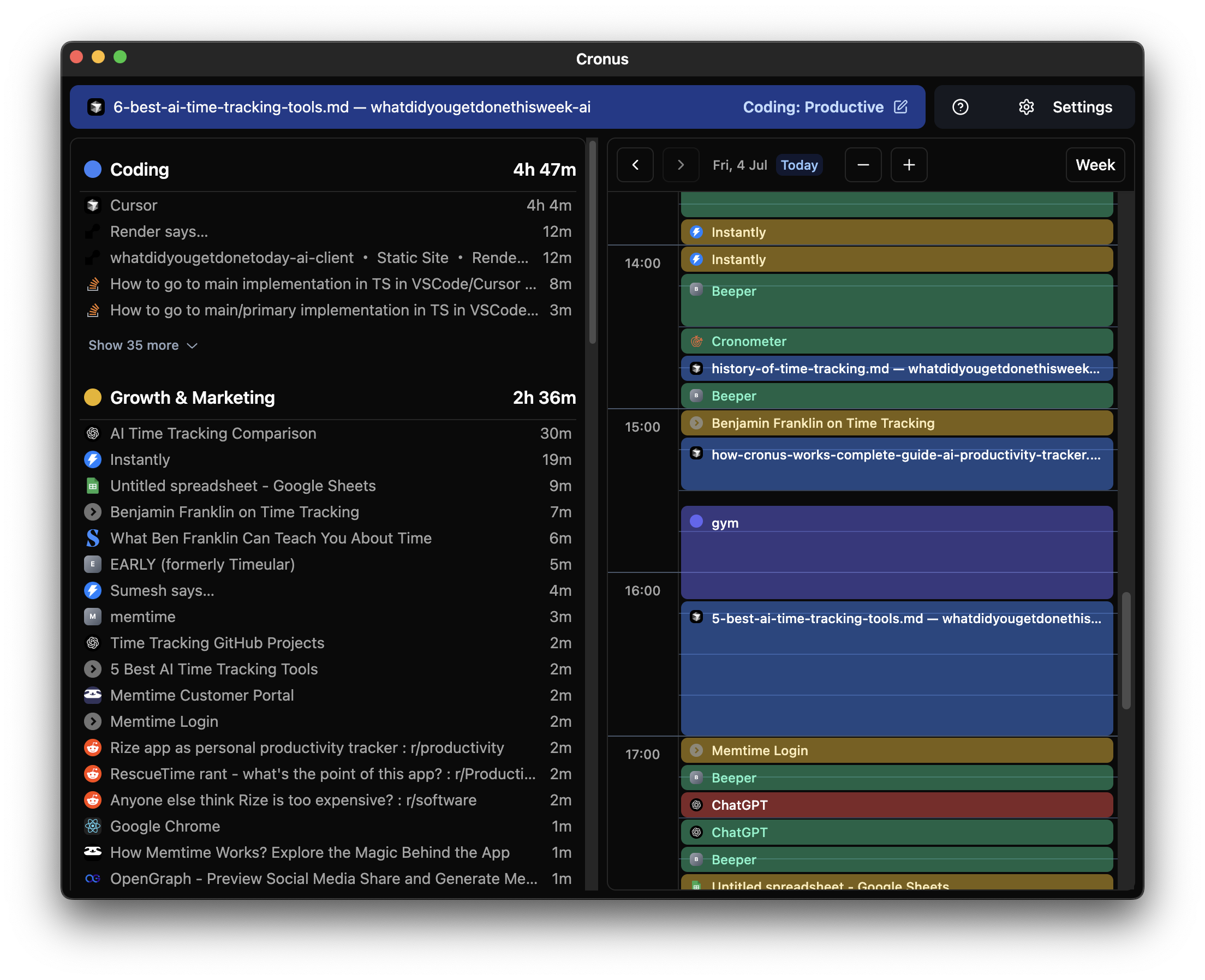
The most expensive decision of the day is usually what to work on next, and it recurs after every interruption.
That is the connection to time tracking, and it is a real one. A fragmented day is not just interrupted work — it is a day containing dozens of "what now" decisions, each drawing from the pool. That is why a day with twelve context switches leaves you exhausted with nothing finished, while a day with two long blocks does not.
Cronus records this automatically on your Mac, with no timer and nothing to log. The number worth having is switches per day, which is usually far higher than people expect.
Once it is a number, the fix is obvious: reduce the switches rather than trying to make better decisions at each one. Batching similar work is not a productivity nicety here — it is the difference between three decisions and thirty.
$6 a month after a 21-day trial, and it never captures your screen: window titles only, redacted on your device.
Limits, plainly: it will not decide anything for you, and it only sees your Mac, so it knows nothing about the fridge at 6pm — which for many people is where decision fatigue actually bites.
One caution about the science
Decision fatigue is usually explained through ego depletion — the idea that willpower is a finite resource that depletes with use. That literature has not replicated well. Several large pre-registered replications have failed to find the classic effects, and it is one of the more prominent casualties of psychology's replication crisis.
So treat the mechanism as uncertain. The experience is real and widely reported, and the practical advice above works regardless of which explanation is right, since all of it reduces the number of decisions rather than relying on any particular theory of why they cost.
Read next
- Analysis Paralysis — when a single decision will not resolve.
- ADHD Routines — converting decisions into structure.
- ADHD Shutdown — what happens when the pool is fully empty.