Time Tracking for Lawyers
We build a time tracker with no billing, no matter codes, no client rates and no trust accounting. For legal billing we are not a candidate, and this post says so early so you can stop reading if that is what you came for.
What follows is what to actually use, and one thing worth measuring alongside it that billing software will never tell you.
Why legal is harder than it looks
Most time tracking advice ignores requirements that are non-negotiable here.
Six-minute increments. Billing in tenths of an hour means rounding rules matter and a tool that records to the minute is not automatically fine.
Matter and client codes. Every entry has to attach to the right matter, and the taxonomy is usually imposed by the firm rather than chosen by you.
Narratives. Entries need a description a client will accept and a billing partner will not send back. This is often the slowest part of the day.
Defensibility. If an entry is challenged, a human has to stand behind it. That rules out unsupervised automatic categorisation as the system of record, which is precisely what we do.
Contemporaneous capture. Reconstructing Tuesday on Friday is both less accurate and, in many contexts, less acceptable.
Any tool that does not handle those five is not a legal time tracker, whatever it says on the site.
What to actually use
Practice management with time built in is where most firms land, because the alternative is reconciling two systems. Clio, PracticePanther, MyCase and Smokeball all include time capture attached to matters, with billing and trust accounting around it. Smokeball in particular leans on automatic capture of document and email work.
Timely is worth a look for smaller practices that do not need full practice management. Its Memory app records in the background and drafts entries you approve, which suits legal work well: the approval step is the defensibility requirement, not friction.
Toggl Track works if your matter structure is simple and you will reliably press start.
We have written more on the general tools in our 2026 roundup, with the caveat that none of them handle matter codes.
The thing billing software will not tell you
Here is the one useful thing we can offer, and it is not a billing product.
Your timesheet is a record of billable work. It is not a record of your week.
The hours it does not contain are the ones that decide whether a practice is actually working:
- Admin, filing, scheduling
- Business development and pitches that went nowhere
- Supervising and answering questions from juniors
- The switching cost of moving between six matters in a day
- Work written off before it reached the bill
None of that appears on a timesheet, and all of it consumes the week. A partner looking at 1,800 billed hours has no visibility into the 600 that were not.
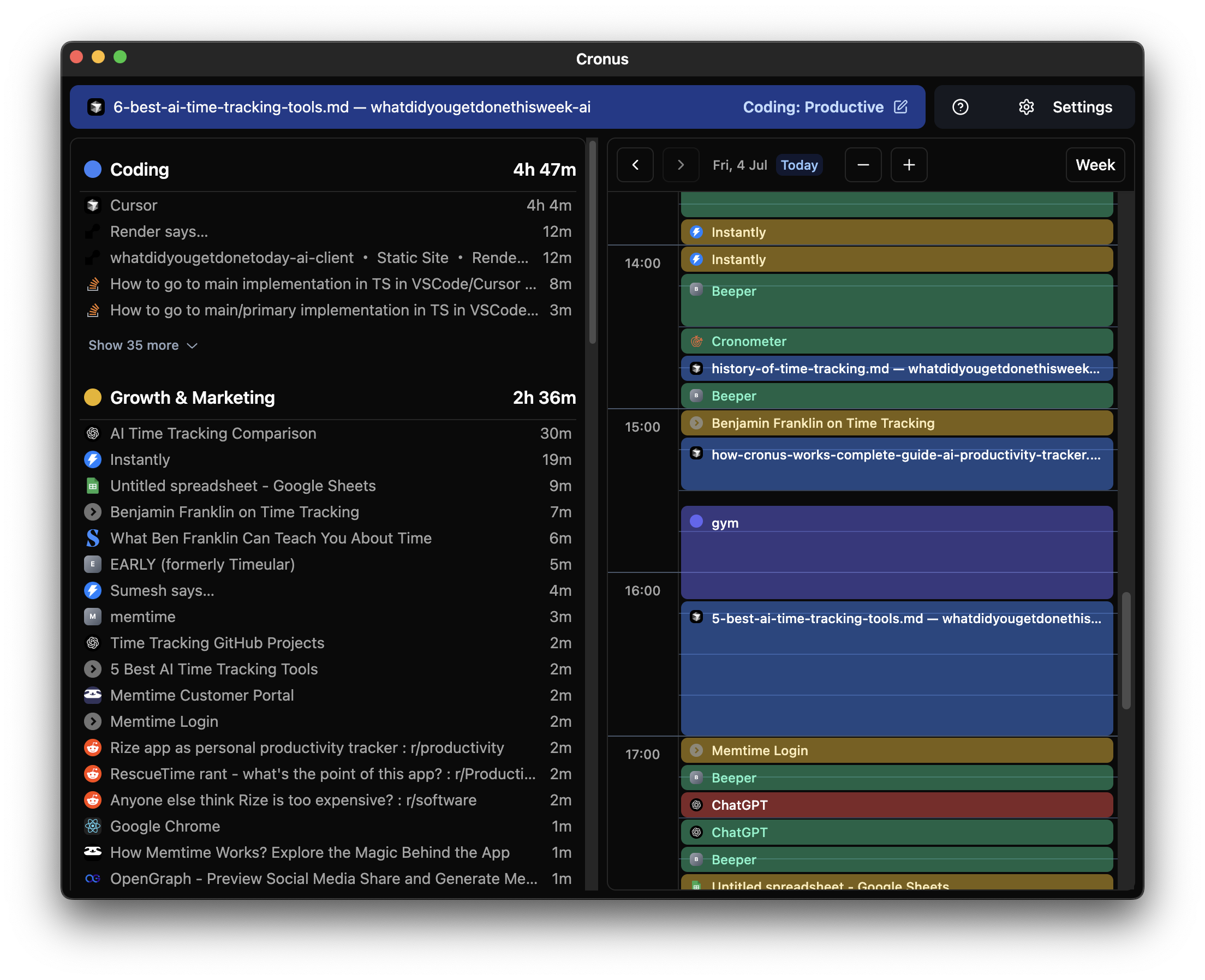
Cronus records where the time actually went, automatically, with no timer and nothing to log. Not to bill from — it produces nothing a client would accept — but to see the shape of the week including the unbilled part.
The two things people find:
Realisation is lower than assumed once written-off and unbilled work is visible.
Fragmentation is worse than assumed. Six matters in a day means five re-entries, and that cost is real, unbillable and invisible.
$6 a month after a 21-day trial, and it never captures your screen: window titles only, with sensitive information redacted on your device before anything is sent.
A necessary caution on confidentiality
This matters more in legal than anywhere else, and we would rather raise it than have you discover it.
Any automatic tracker sees window titles. Window titles routinely contain client names, matter names and document titles. That is true of us and of every other automatic tool.
Cronus never captures your screen and redacts sensitive information on-device before transmitting, but metadata does leave your machine, and we are not going to describe ourselves as local-only. Before installing any automatic tracker on a machine holding privileged material, check it against your firm's confidentiality obligations and IT policy. If the answer is that nothing may leave the device, the honest options are local-only tools or nothing.
That is a real constraint, and it is a good reason for many lawyers not to use us.
The short version
For billing: practice management software, or Timely for a small practice.
For understanding the week: something automatic, if your confidentiality position allows it.
Do not try to make one tool do both. A billing record needs a human signature. A picture of your week needs to happen whether you were paying attention or not.
Read next
- Time Tracking for Consultants — the same split, less regulated.
- AI Time Tracking Privacy in 2026 — what each architecture actually sees.
- Too Many Meetings — where the unbillable hours usually go.