The Shutdown Ritual
You close the laptop at six and keep working anyway — in the shower, at dinner, at eleven at night when you remember the thing you did not send.
A shutdown ritual is a short, fixed routine at the end of the working day that stops this. Cal Newport popularised the term in Deep Work, and the underlying idea has better support than most productivity advice.
Why unfinished work follows you
Unfinished tasks stay active in a way finished ones do not. This is the Zeigarnik effect, from Bluma Zeigarnik's 1927 finding that people remembered interrupted tasks better than completed ones. The original studies are old and the effect has had a mixed replication record, so treat the classic version cautiously.
What has held up better is the more specific finding from Masicampo and Baumeister: unfulfilled goals intrude on your thinking, and the intrusion stops not when the task is done but when you make a plan for it. Writing down when and how you will finish something released the mental load about as well as finishing it.
That is the whole mechanism, and it tells you exactly what a shutdown ritual needs to do. It is not about tidying. It is about converting open loops into written plans, because a plan is what lets your brain put something down.
The five-minute version
Same time, same order, every working day.
1. Empty the inputs. Inbox, messages, notes app, scraps of paper. Not answering them — just getting everything into one place so nothing is still floating.
2. Write tomorrow's first task. One line, specific enough to start without deciding anything: "open the migration PR and address the review comments", not "migration". The first fifteen minutes of tomorrow is the hardest moment of the day, and this removes the decision from it.
3. Note where you stopped. Two lines on the state of the thing you were in the middle of. This is the step that does the most work, and the one people skip.
4. Look at tomorrow's calendar. Ten seconds. It prevents the 9am surprise, and it lets you stop wondering.
5. Say something to mark the end. Newport's version is a spoken phrase. A closing gesture works as well — shutting the laptop deliberately, clearing the desk, leaving the room. It sounds silly and it functions as a cue, which is the point.
Then stop. The ritual only works if it actually ends the day; if you keep checking email at nine, you have taught yourself the ritual means nothing.
Why it works when a to-do list does not
A to-do list is a list of open loops. It records what is unfinished without deciding anything about it, which is why reviewing your list at 10pm makes things worse rather than better.
The shutdown ritual differs in one respect: every item gets a decision. Captured, planned for tomorrow, or explicitly deferred. Decided things stop intruding; listed things do not.
Making it stick
Anchor it to an event, not a time. "After my last meeting" or "when I close the laptop" beats "at 6pm", which requires you to notice 6pm.
Keep it short. Five minutes. A twenty-minute review is a thing you will skip on the days you most need it.
Do it on bad days especially. The instinct on a chaotic day is to skip it and flee. That is the day with the most open loops, and the day the ritual is worth the most.
Do not use it to work. The temptation is to answer one more email during step 1. Then it is not a shutdown.
The version for people who cannot stop
If the problem is not that work follows you but that you genuinely cannot stop working, a ritual is not enough on its own. Add an external cue: an alarm you have to stand up for, a scheduled call, someone expecting you. Anything requiring only your own noticing will lose. See hyperfocus.
Knowing whether it worked
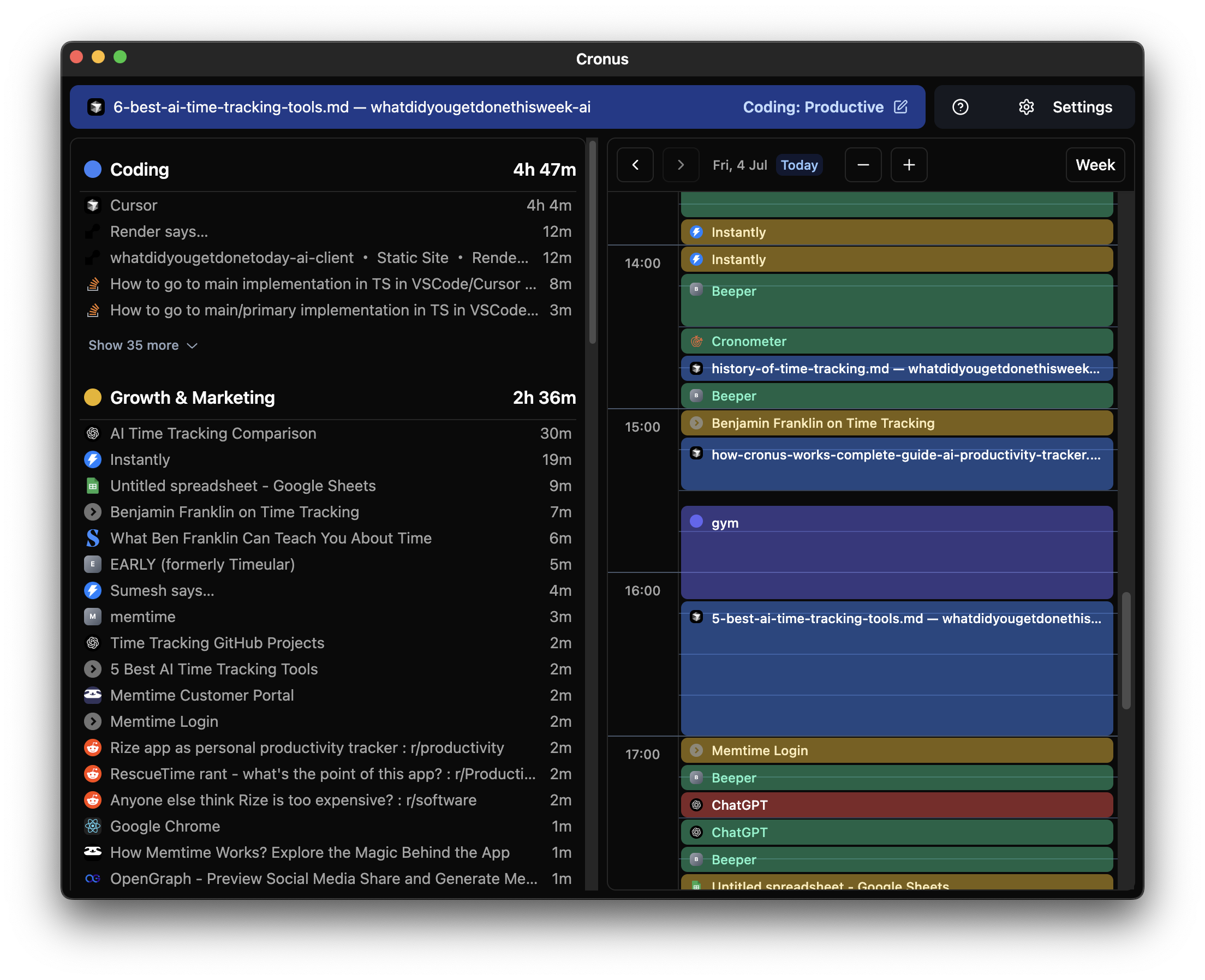
The claim to test is whether the working day actually ends, and impressions are poor evidence — the evening email that took four minutes leaves no memory, while the one difficult evening feels like every evening.
Cronus records what happened on your Mac automatically, with no timer and nothing to log. The relevant number is simple: when did work actually stop, and how often was there a second session after dinner.
Two weeks with the ritual and two without answers it. If the last activity moves from 22:40 to 18:15, that is a real change worth keeping.
$6 a month after a 21-day trial, and it never captures your screen.
Limits worth stating: it cannot see thinking about work, which is most of what the ritual is meant to stop. It sees whether you reopened the laptop. That is a proxy, and it is the honest one available.
Read next
- Weekly Planning — the weekly-scale version of the same idea.
- Time Anxiety — when the intrusion is broader than one unfinished task.
- ADHD Hyperfocus — when stopping is the actual problem.
Sources: Masicampo & Baumeister (2011), Consider It Done! Plan Making Can Eliminate the Cognitive Effects of Unfulfilled Goals, JPSP · Newport, Deep Work (2016)