Weekly Planning
A weekly plan is worth more than a daily one, for a reason that is not obvious: a week is the smallest unit that survives a bad day.
Plan a day and one interruption ruins it. Plan a week and Tuesday going wrong is absorbed. That is the whole case for doing this, and it also tells you how to build the plan — with the bad day already priced in.
Why most weekly plans fail
They are built from optimistic estimates. Sunday evening you are rested and the work looks tractable. You allocate accordingly, and by Wednesday you are three tasks behind with no idea whether the estimates or the week were at fault.
They assume a clear week. Nobody plans for the meeting that appears on Tuesday, the thing that breaks, or the colleague who needs an hour. These are not exceptions; they are the normal contents of a week, and a plan with no room for them is a plan that fails on contact.
They contain too much. A list of fifteen priorities is a list of zero priorities, and it guarantees the week ends in deficit however much you did.
They plan tasks, not time. "Finish the migration" is not a plan. It has no duration, so it cannot be checked against a week that only has so many hours in it.
They never get reviewed. A plan you do not look back at cannot teach you anything, so next week is built on the same wrong estimates.
The 30-minute system
Once a week, same slot. Friday afternoon beats Monday morning, because Friday still has the week in memory and Monday has already started.
1. Look back (10 minutes). Before planning anything, review what actually happened.
- What did you finish?
- What did you plan and not do, and why?
- Where did the time actually go?
That third question is the one people skip and it is the one that makes the rest work. You cannot estimate next week without knowing what last week cost.
2. Pick three outcomes (5 minutes). Not fifteen. Three things that, if done, make it a good week. Write them as outcomes rather than activities: "reconciliation job shipped", not "work on reconciliation".
Three is not a productivity aesthetic. It is roughly what a real week with meetings, admin and one thing going wrong can actually deliver.
3. Estimate, then add half (5 minutes). Put an hour figure on each. Then multiply the total by 1.5. Almost everyone underestimates, consistently and in the same direction, and the multiplier is cheaper than being wrong every week. If the inflated total does not fit the week, you have too many outcomes — cut one now rather than failing at it on Thursday.
4. Block the time (5 minutes). Actual calendar blocks for the three outcomes, placed in your good hours, before other people fill them. Unblocked work does not happen; it gets displaced by whatever is louder.
5. Leave 20% empty (5 minutes). This is the step that separates plans that survive from plans that do not. The empty time is not slack you might use — it is where the unplanned week goes. If you do not reserve it, the unplanned work displaces your three outcomes instead.
That is it. Thirty minutes, once a week.
The rules that make it hold
One review, not constant re-planning. Re-planning midweek is usually avoidance dressed as organisation.
Protect the blocks like meetings. A block you will move for anything is not a block.
Meetings at the edges, deep work in the middle of your good hours. A meeting at 11am costs more than the same meeting at 9am, because it destroys the morning rather than bracketing it. More on that here.
If you consistently hit all three outcomes, add a fourth. If you consistently miss, cut to two. Calibrate against evidence rather than ambition.
Carry forward without guilt. An unfinished outcome is information about your estimates, not a moral failure.
The part that makes it work
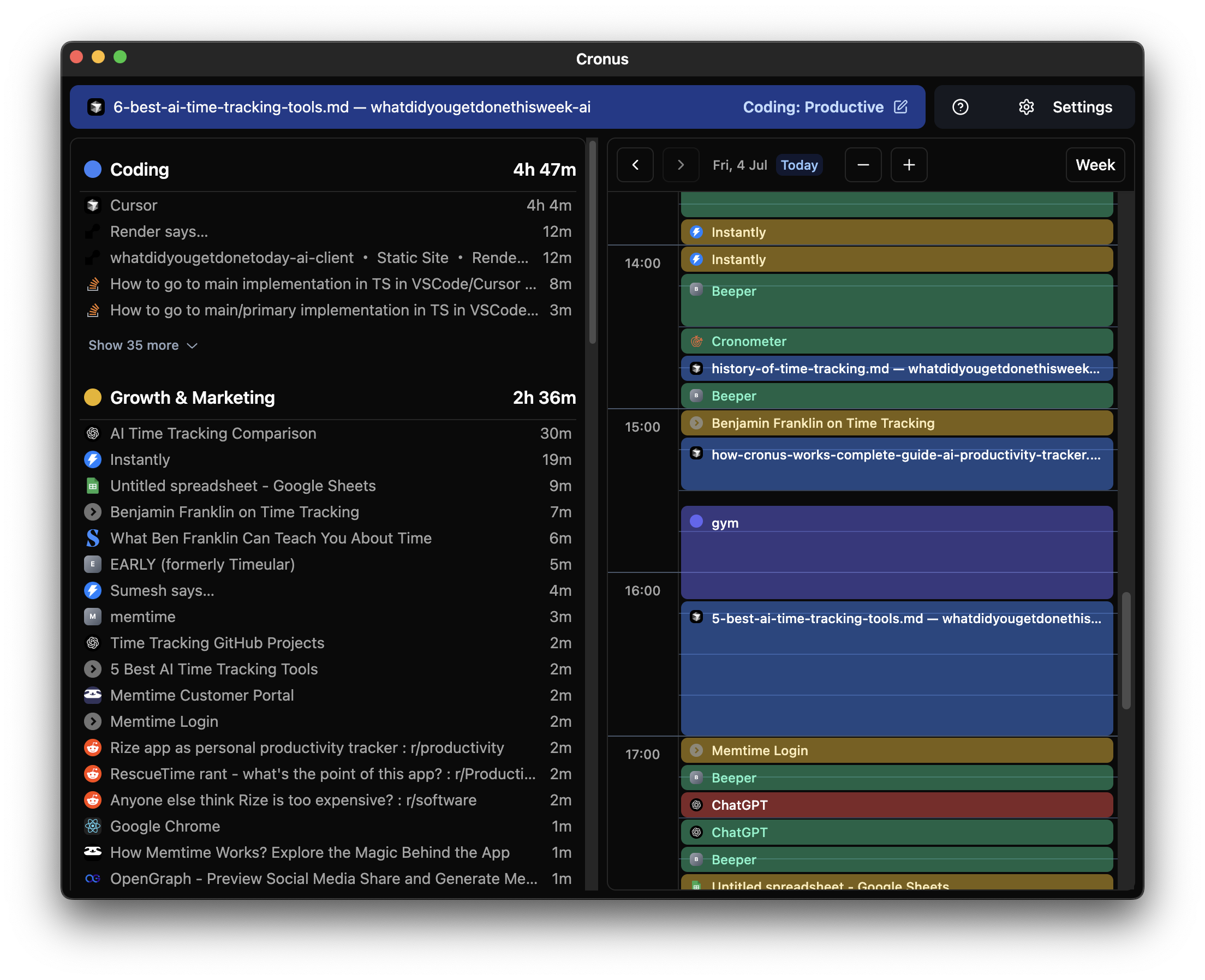
Step 1 asks where the time actually went, and almost nobody can answer it. That is why weekly planning so often degrades into a wish list: without a real account of last week, every plan is built from an impression.
And impressions are unreliable in a documented way. In a randomised controlled trial, experienced developers estimated a tool had made them 20% faster on real tasks from their own repositories. Measured, they were 19% slower — a forty percentage point error about work they had just finished. The full study.
Manual tracking does not fill the gap either, because it needs an action at every task switch, so it captures your calm days and misses your chaotic ones — which is exactly backwards for planning.
Cronus records it automatically on your Mac, with no timer and nothing to log. What that gives your Friday review is three numbers you cannot otherwise get:
How many hours actually went to your three outcomes. Usually far fewer than expected, and this alone fixes chronic over-planning.
What consumed the rest. Meetings, admin, switching. The 20% buffer becomes a calibrated figure rather than a guess.
Your real available hours. Not 40. The number left after everything that was never optional.
$6 a month after a 21-day trial, and it never captures your screen: window titles only, redacted on your device.
Honest limits: it sees desk work on a Mac, so meetings away from the laptop and thinking on a walk are invisible. And it measures the shape of your work, not its quality — three hours on the right thing and three on the wrong thing look identical.
If planning has never worked for you
Two things worth considering before trying a sixth system.
If you cannot start the planned work, the plan is not the problem. Planning is enjoyable and productive-feeling in a way the work is not, and an elaborate system can be avoidance with a nice interface. See ADHD paralysis, which describes the mechanism whether or not the label applies to you.
If the week is genuinely not yours to plan — reactive support work, shift work, a job that is 80% meetings — then outcome-based planning will fail no matter how it is built. In that case plan one outcome, not three, and treat the rest as the job it actually is.
Read next
- Time Blocking: Why It Fails — the daily-level version, and its failure modes.
- How to Do a Time Audit — a deeper version of step 1.
- Too Many Meetings — what usually eats the 20%.