The Multitasking Myth
The claim is familiar: multitasking is a myth, you are really task switching, and it costs you 40% of your productivity.
The first half is well supported. The second half is a number that has escaped from its original context and now gets quoted about situations it was never measured on. Both are worth getting right, because the correct version still leads to the same practical conclusion.
What is genuinely established
You cannot attend to two demanding things simultaneously. For anything requiring conscious attention, the brain alternates. This is not controversial and it has been shown many times over.
Switching has a measurable cost. Task-switching experiments consistently find that alternating between tasks is slower and more error-prone than doing them in blocks. This is one of the more robust findings in cognitive psychology.
Some combinations genuinely are simultaneous. Walking and talking, driving a familiar route and holding a conversation. Automatic, well-practised tasks do not compete for the same resource. The rule applies to tasks needing conscious attention, not to everything.
Self-assessed multitaskers are not better at it. Ophir, Nass and Wagner's 2009 Stanford study found that people who multitasked most heavily with media performed worse on tests of filtering irrelevant information and switching tasks. The finding is frequently inflated into claims about permanent brain damage, which it does not support, but the core result — heavy multitaskers are not the exception they believe themselves to be — has held up reasonably well.
What gets overstated
The "40% productivity loss" figure. It traces back to work by Rubinstein, Meyer and Evans on task-switching costs, measured in laboratory conditions on short, artificial tasks. It is real for what it measured. It is not a general law about your working day, and it does not mean someone who checks Slack loses 40% of their output. Treat any single percentage on this subject with suspicion, including that one.
"It takes 23 minutes to refocus." From Gloria Mark's research on interrupted work, and widely mangled. The finding concerns how long before people return to the original task, typically having done other tasks in between — not 23 minutes of staring blankly. The real point of her work is subtler and more interesting: interrupted work is often completed faster, but at the cost of higher stress and effort.
"Multitasking lowers your IQ more than cannabis." This came from a small, unpublished, employer-commissioned study. It is not a finding worth repeating.
Permanent damage claims. The correlational studies cannot establish direction. Heavy multitaskers may filter worse, or people who filter worse may gravitate toward multitasking. Nobody has shown it rewires your brain.
The pattern is worth noticing: the underlying research is solid and moderate, and the popular versions are inflated. You do not need the exaggerations. The real effect is large enough to act on.
What the cost actually consists of
Resumption lag. After switching there is a period where you are working but not yet at full depth. It is invisible — it does not feel like anything — which is why it is so consistently missing from people's estimates.
Attention residue. Part of your attention stays on the previous task, particularly if it was unfinished. Sophie Leroy's work on this is why a five-minute interruption can cost far more than five minutes.
Error rates. Switching increases mistakes, and mistakes cost more time than the switch did.
Working memory loss. Anything held in your head has to be rebuilt, which is why a two-minute interruption to complex work is disproportionately expensive.
What actually helps
Batch by context, not by priority. All the email at once, all the calls at once. Every context change is a rebuild, and grouping converts twelve rebuilds into three.
Protect one long block rather than the whole day. Two uninterrupted hours are worth more than five fragmented ones. Defending everything fails; defending 9:00–11:00 works.
Close the other things. Not minimise. An open tab you are aware of competes for attention.
Finish, or write down where you were. Attention residue attaches to unfinished work. Two lines noting the state releases most of it.
Move meetings to the edges. A meeting at 11am destroys a morning; the same meeting at 9am does not. More here.
Leave the automatic combinations alone. Music while doing admin, a podcast while cleaning. The research concerns competing conscious attention, and applying it to everything is a misreading.
The one number worth having
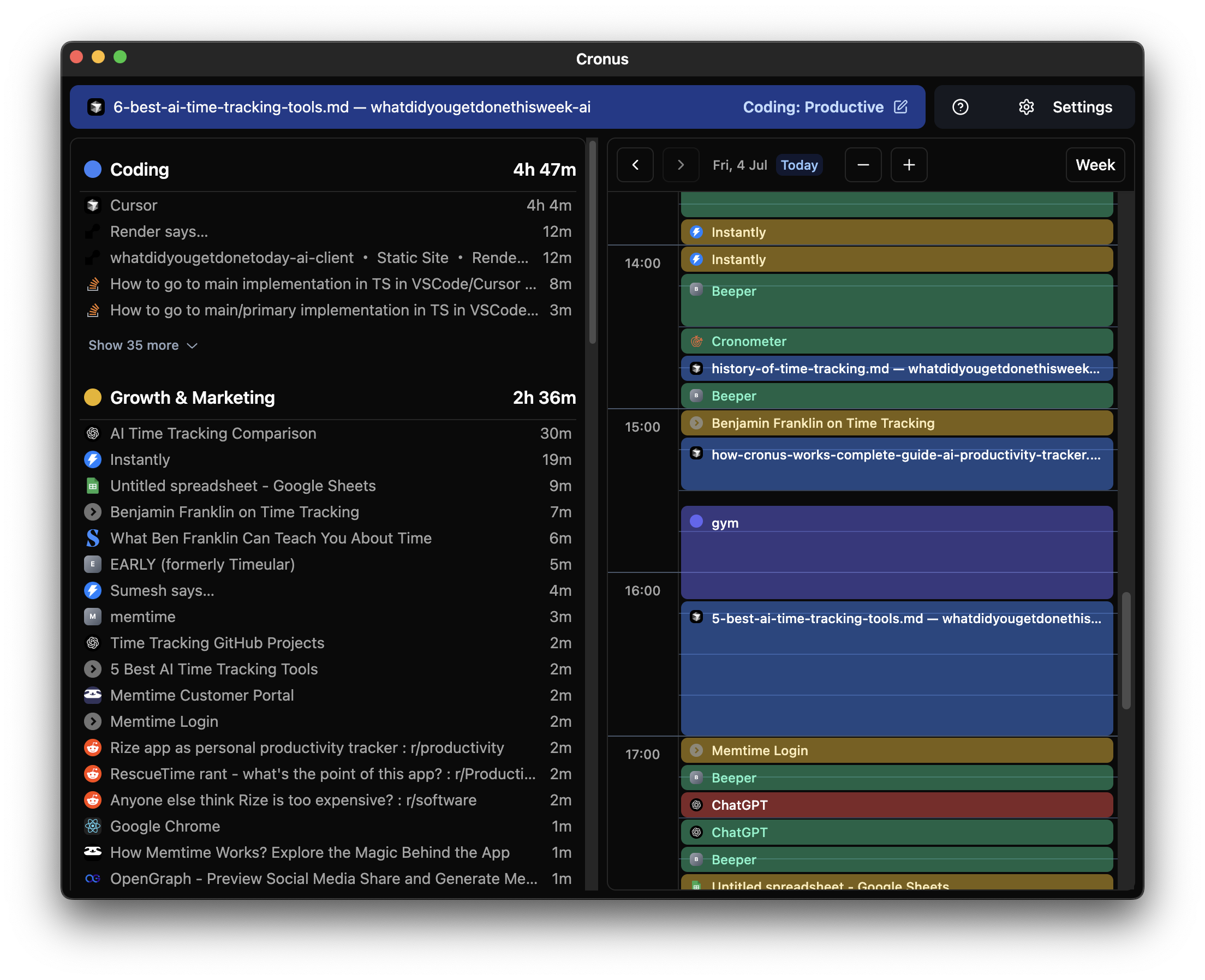
Forget percentages from studies that were not measuring your job. There is a number specific to you that matters more: how many times a day you switch context, and how long your longest unbroken block actually is.
Almost nobody knows theirs, and estimates are unreliable. In a randomised controlled trial, experienced developers estimated a tool had made them 20% faster on real tasks; they were 19% slower — a forty percentage point error about work they had just finished. The study.
Cronus records it automatically on your Mac, with no timer and nothing to log — which matters here, because a manual log needs an action at the switch, and the switch is the thing being measured.
Two findings that tend to change behaviour: switches per day is usually far higher than people guess, and the longest unbroken block is usually far shorter. When the answer is 22 minutes, "I need to focus more" becomes "my calendar is structured wrong", which is a fixable problem rather than a character one.
$6 a month after a 21-day trial, and it never captures your screen.
Fair limits: it measures the shape of your attention, not its quality, and it cannot see interruptions away from the laptop — someone at your desk, a phone call — which for many people are the majority.
The short version
You are switching, not multitasking, and switching costs real time through resumption lag, attention residue and errors. That is well established.
The famous numbers are not, and you do not need them. Batch by context, protect one block, close the other things, and measure your own switch count rather than trusting a statistic gathered on undergraduates doing arithmetic.
Read next
- Too Many Meetings — the largest source of imposed switching.
- Where Did My Day Go? — fragmentation as the usual culprit.
- Monotropism — why switching costs some people far more.