How Many Work Hours Are in a Year?
The short answer: 2,080 hours. That is 40 hours a week × 52 weeks, and it is the figure payroll, salary calculations and contracts use.
It is also not how many hours are actually in your working year. 2026 contains 261 weekdays, and after federal holidays it contains 250 working days, or 2,000 hours.
For your own dates, holidays and leave, the work hours calculator does this arithmetic for any range, and the overtime calculator handles anything past forty.
Looking for the literal number of hours in a year rather than working hours? 8,760 — that is 365 × 24. A leap year has 8,784. There are 8,766 hours in an average calendar year once leap years are accounted for.
Here is the full arithmetic, then the number that matters more than either.
2026 at a glance
| Days | Hours (at 8/day) | |
|---|---|---|
| Total days | 365 | — |
| Weekdays (Mon–Fri) | 261 | 2,088 |
| Less federal holidays | −11 | −88 |
| Working days | 250 | 2,000 |
| Less 10 days PTO | −10 | −80 |
| Actually scheduled | 240 | 1,920 |
2026 begins and ends on a Thursday, which gives it 53 Thursdays and 261 weekdays overall.
All 11 US federal holidays fall on a weekday in 2026, which is unusually convenient. In many years one or two land on a weekend and are either observed on an adjacent weekday or lost, depending on your employer.
| Date | Day | Holiday |
|---|---|---|
| 1 Jan | Thu | New Year's Day |
| 19 Jan | Mon | Martin Luther King Jr. Day |
| 16 Feb | Mon | Presidents' Day |
| 25 May | Mon | Memorial Day |
| 19 Jun | Fri | Juneteenth |
| 3 Jul | Fri | Independence Day (observed) |
| 7 Sep | Mon | Labor Day |
| 12 Oct | Mon | Columbus Day |
| 11 Nov | Wed | Veterans Day |
| 26 Nov | Thu | Thanksgiving |
| 25 Dec | Fri | Christmas Day |
Independence Day falls on a Saturday in 2026, so it is observed on Friday 3 July.
2027 also has 261 weekdays, beginning and ending on a Friday.
The other common figures
2,080 hours — 40 × 52. The standard payroll year. Ignores holidays and leave entirely, which is deliberate: it is a rate basis, not a schedule.
2,087 hours — the figure the US federal government uses for converting annual salaries to hourly rates. It averages the varying number of weekdays across years, which is why it is not a round number.
1,920 hours — a realistic full-time year with 10 days of PTO and federal holidays off.
1,760 hours — closer to a European year, with statutory leave of 20–25 days plus public holidays.
Part-time: halve or scale as needed. 20 hours a week is 1,040 on the payroll basis, 1,000 actual in 2026.
To convert your own: working days × hours per day. Or use our hours calculator, which will do it including breaks.
Why the number you were looking for might be wrong
Most people arrive at this question for one of three reasons, and each needs a different figure.
Converting a salary to an hourly rate. Use 2,080. It is the convention, it is what employers use, and using anything else makes your number incomparable to everyone else's.
Costing a project or a hire. Use around 1,900. A full-time employee does not deliver 2,080 hours of work; holidays, leave and sick days are real. Budgeting at 2,080 is how projects end up late by exactly the amount of leave nobody counted.
Working out what your time is worth. Neither figure is right, and this is the interesting case.
The number nobody publishes
Here is where every other page on this topic stops, and where the actually useful number is.
Scheduled hours are not worked hours, and the gap runs in both directions.
Downward, from the scheduled total:
- Meetings that could have been an email
- Admin, expenses, compliance training, tooling
- The re-entry cost after every interruption, which is real and uncounted
- The stretch after lunch, or after a bad meeting, where nothing lands
Upward, beyond the scheduled total:
- Email in the evening
- Thinking about a problem on the commute
- The Sunday hour spent getting ahead
Both are invisible. So a person nominally working 1,920 hours might be doing 1,400 hours of actual work while being mentally occupied for 2,200 — and would not be able to tell you which.
That gap is the reason "how many work hours in a year" is a less useful question than it looks. The calendar arithmetic is exact and easy. What you do with the hours is neither, and it is the part that decides anything.
Finding your real number
People are strikingly bad at estimating their own working time. In a randomised controlled trial, experienced developers estimated a tool had made them 20% faster on real tasks from their own repositories. Measured, they were 19% slower — a forty percentage point error about work they had just finished. The full study.
If people are that wrong about a task they just completed, an annual self-estimate is not worth much.
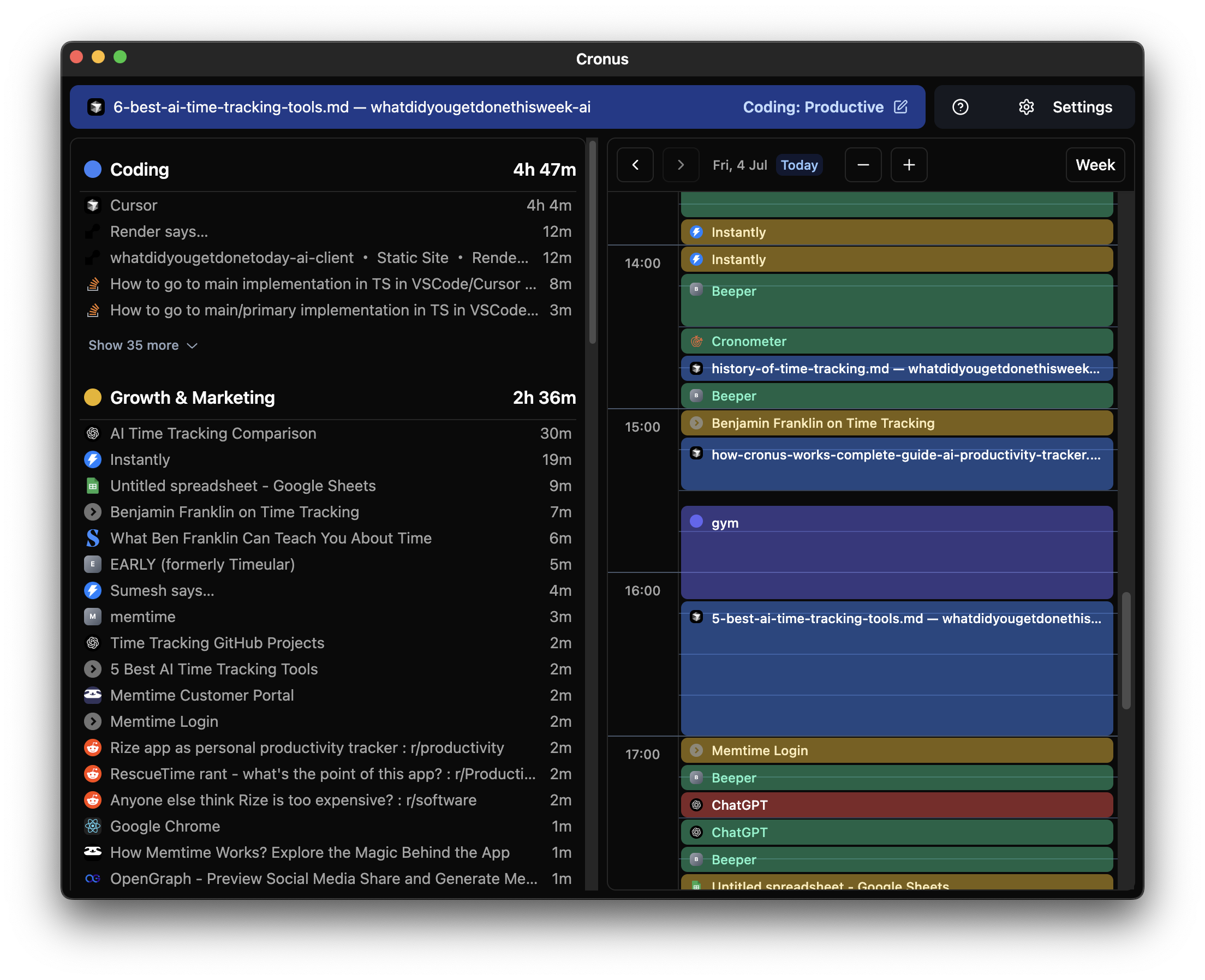
Cronus records where your time actually goes on your Mac, automatically, with no timer and nothing to log. Over a few weeks it gives you a real annual figure rather than a contractual one, along with the two numbers that usually matter more: how much went to the work you meant to do, and how fragmented it was.
The common findings are that total hours are higher than assumed and focused hours are much lower, and those two together explain the feeling of working constantly and finishing nothing.
$6 a month after a 21-day trial, and it never captures your screen: window titles only, with sensitive information redacted on your device.
Limits worth stating: it sees desk work on a Mac, so meetings away from the laptop, phone calls and thinking on a walk are invisible. And it measures the shape of your work, not its quality.
Quick reference
- Hours in a year: 8,760 (8,784 in a leap year)
- Weeks in a year: 52 weeks and 1 day (52 and 2 days in a leap year)
- Weekdays in 2026: 261
- Working days in 2026 after federal holidays: 250
- Standard payroll year: 2,080 hours
- Federal conversion figure: 2,087 hours
- Realistic full-time year with 10 days PTO: 1,920 hours
Read next
- Hours Calculator — work out your own, including breaks.
- Where Did My Day Go? — why scheduled and worked hours diverge.
- Meeting Cost Calculator — what a recurring meeting costs across a year.