Commute Time
The average one-way commute in the United States is around 27 minutes, according to the Census Bureau's American Community Survey. Call it an hour a day door to door.
An hour a day is roughly 220 hours a year, or about nine full 24-hour days. Over a forty-year career, close to two and a half years of waking life. The time duration calculator will total your own door-to-door figure across a week.
Those numbers get quoted a lot. They also understate the cost, for reasons worth understanding before you decide what to do about it.
Why the minutes understate it
The day is bracketed, not shortened. A commute does not remove an hour from the middle of your day. It removes the hour at each end, which is where recovery, exercise, cooking and family time live. The hour comes out of the discretionary part of the day, not the working part.
Recovery does not start at the door. Decompression after a bad commute takes time that nobody counts as commuting.
It compresses the morning. An hour of travel usually means more than an hour earlier alarm, because everything before it has to happen sooner too. Commuting quietly costs sleep.
Variable commutes cost more than long ones. This is the finding that surprises people. A predictable 45 minutes is easier to live with than an unpredictable 20-to-50, because you have to budget for the worst case every single day. Unreliability is worse than duration.
The research is unusually consistent
Most productivity claims rest on shaky evidence. This one does not.
Long commutes are repeatedly associated with lower life satisfaction, higher reported stress and anxiety, and worse sleep. UK research using the National Travel Survey and household panel data has found commuting time associated with reduced satisfaction with leisure time and with job satisfaction, with effects strong enough to matter at a population level.
The mode matters and not in the way people assume. Driving and, especially, crowded public transport score worst. Walking and cycling commutes are consistently associated with better wellbeing than driving — sometimes better than no commute at all, because they bundle exercise and a transition into the same time.
And the "commuting paradox", from Stutzer and Frey's well-known work: people accept longer commutes for better pay or housing, and consistently fail to adapt to the cost the way they adapt to most other things. The compensation does not make up for it, and people keep making the trade anyway.
The practical upshot: treat a commute as a real, ongoing cost when you evaluate a job or a home, not as a neutral gap between them. Most people systematically undervalue it.
What actually helps
Cut variability before you cut length. Leaving fifteen minutes earlier to move outside peak congestion often removes more stress than moving closer would.
Change the mode if you possibly can. Walking or cycling part of the route is the single best-supported intervention here, and it converts dead time into exercise you were otherwise going to skip.
Do not turn it into work time. The instinct is to reclaim the commute with calls or email. The evidence points the other way: the transition is doing something useful. A commute spent on work extends the working day at both ends and removes the buffer that makes arriving home tolerable.
Use it for one deliberate thing. An audiobook, a podcast, a language, or nothing at all. One decision made once beats a daily negotiation.
Negotiate days, not policy. Two remote days removes 40% of an annual commute, which is a far larger win than most schedule optimisations, and it is usually easier to get than a policy change. See return to office for how to frame it.
Cluster your office days. Same number of commutes, but consecutive days mean one disrupted routine rather than two.
The part worth measuring
Here is the question people get wrong: does working from home actually give you the commute back?
Frequently it does not. The recovered hour goes to a calendar that expands to fill it, to starting earlier, or to a working day that no longer has a clear end. The commute vanishes and the time does not appear anywhere you would want it.
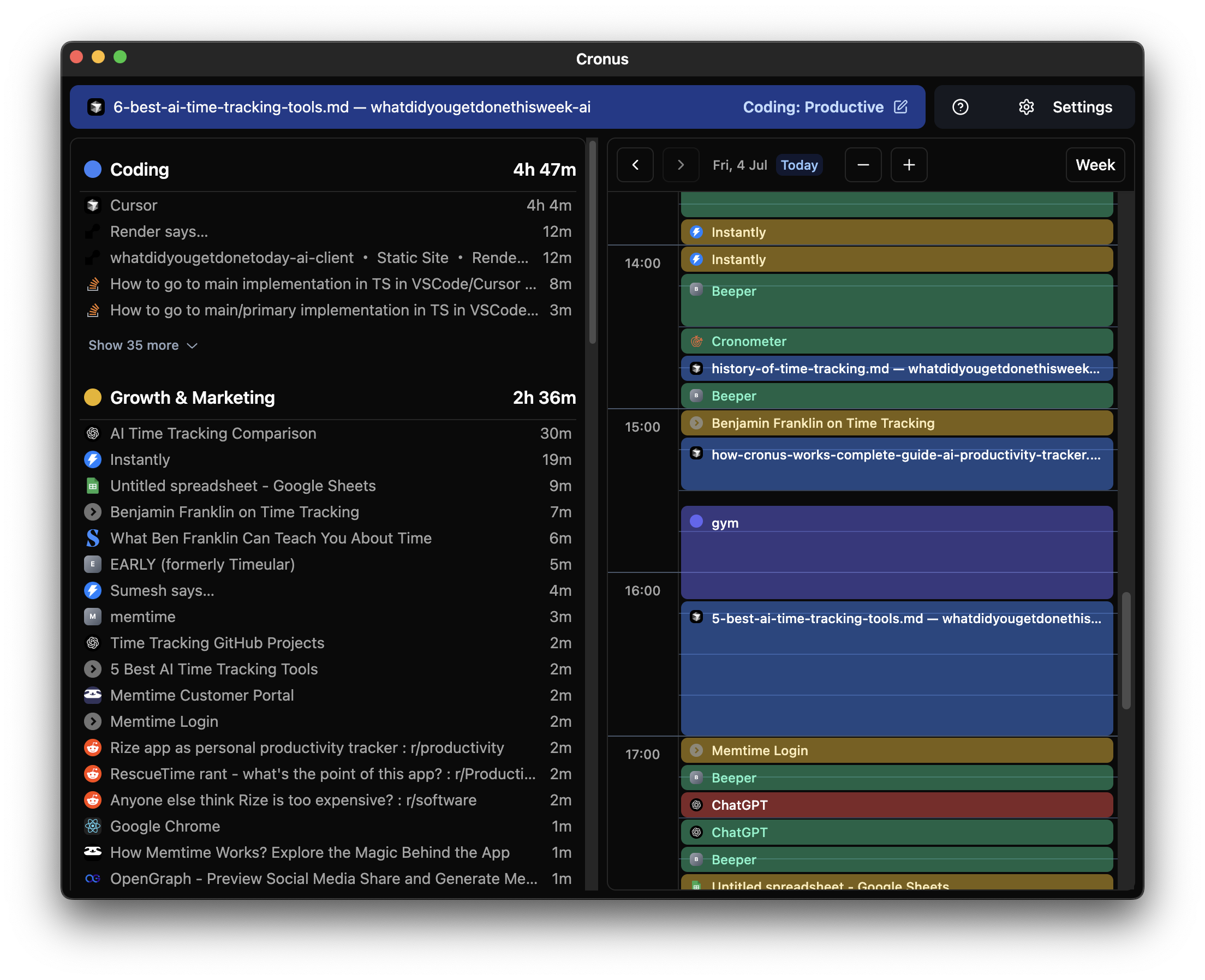
That is checkable rather than arguable. Cronus records where the time goes automatically on your Mac, with no timer and nothing to log. Compare an office week with a home week and you get the honest answer: whether the two hours came back as time off, or whether the working day simply grew by two hours.
The common finding is the second one, and it is worth knowing, because the fix is a boundary rather than a commute.
$6 a month after a 21-day trial, and it never captures your screen.
Obvious limit: it runs on your Mac, so it cannot see your commute at all. It tells you what happened to the time at the other end, which is the part you can actually change.
Read next
- Return to Office — what the evidence does and does not support.
- Real Estate Agent Time Management — for jobs where drive time is the job.
- Time Anxiety — the feeling that the hours are going somewhere wrong.
Sources: US Census Bureau, American Community Survey — commuting · Stutzer & Frey (2008), Stress that Doesn't Pay: The Commuting Paradox, Scandinavian Journal of Economics · UK Department for Transport, Commuting and Wellbeing