Real Estate Agent Time Management
Most time management advice assumes you sit at a desk. Real estate does not work like that, and the largest cost in the job is invisible to every tool written for desk workers, including ours.
We make a macOS app. It cannot track your car. So this page starts with the tools that can, because for an agent that is the part that matters most.
Drive time is the real number
An agent's day is not mostly showings. It is mostly getting to showings.
Three properties across a metro area can be five hours, of which perhaps ninety minutes is with a client. The rest is driving, parking, waiting, and the dead ten minutes at each end that never appear anywhere.
Two things follow, and both are worth money.
Drive time is deductible, and most agents under-claim it. Business mileage can be deducted at the IRS standard mileage rate, which changes annually, so check the current year's figure. Agents reconstructing mileage from memory at tax time routinely lose thousands of dollars of legitimate deduction, because reconstruction always undercounts. A mileage log made contemporaneously is worth real money and a reconstructed one is both worth less and weaker if examined.
Drive time decides which listings are worth taking. A listing 40 minutes away is not the same listing as one 10 minutes away, even at the same commission. Very few agents calculate this, and the ones who do change what they accept.
What to use for the car
These run on your phone, detect drives automatically and classify them business or personal.
MileIQ — the simplest. Detects every drive, swipe right for business, left for personal. Does one thing well.
Everlance — mileage plus expenses and receipts, which suits agents who also track marketing spend and staging costs.
Hurdlr — mileage, expenses, income and real-time tax estimates. The strongest option if you want the tax picture rather than just the log.
Stride — free, aimed at self-employed people generally, fine if all you need is a defensible log.
Timeero — GPS with time tracking attached, built for teams in the field. Overkill for a solo agent, sensible for a brokerage with a field team.
Any of these beats a spreadsheet, for one reason: they run without you remembering, and the drives you forget to log are the ones that cost you.
The desk half
The rest of the job is real and also poorly accounted for. CRM updates, listing preparation, photo and copy work, MLS entry, contract paperwork, comparative market analyses, marketing, and the long tail of email and messaging that fills every gap.
Agents consistently underestimate this. It gets done in fragments between appointments, so it leaves almost no memory, and at the end of the week the impression is "I was showing properties all week" when the record says otherwise.
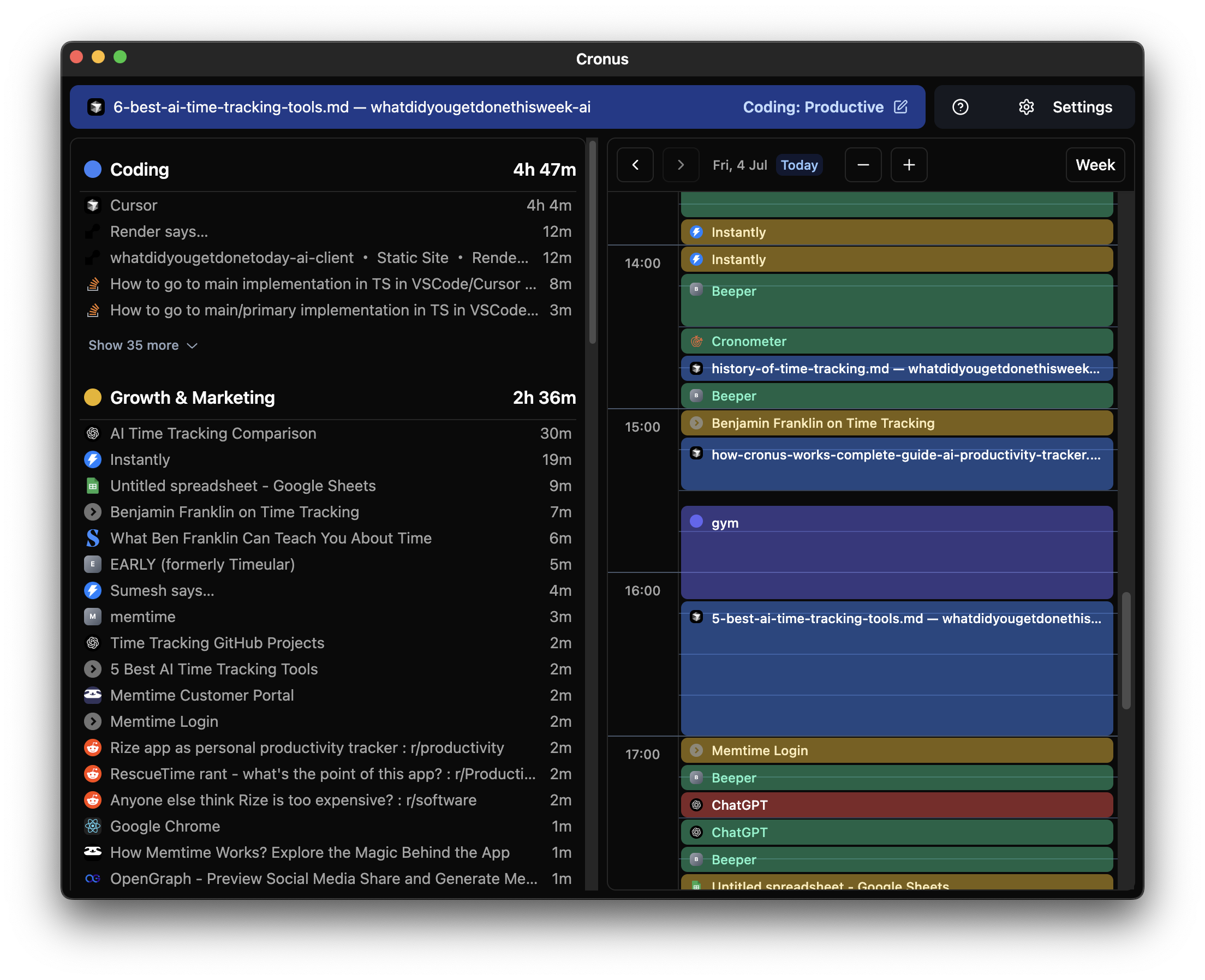
This half is where Cronus is useful. It records what you actually did on your Mac, automatically, with no timer and nothing to log, which matters here because your desk work happens in ten-minute fragments you would never open a timer for.
What it tends to show: admin is a much larger share than expected, and lead generation is a much smaller one. That second finding is the one that changes behaviour, because prospecting is the activity everyone intends to protect and the first thing a transaction displaces.
$6 a month after a 21-day trial, and it never captures your screen: window titles only, with sensitive information redacted on your device before anything is sent. Worth noting, since window titles in this job contain client names and addresses.
What it will not do: track your car, your showings, your calls from the road, or anything happening away from the laptop. For an agent that is a large share of the working day, so treat it as half a picture. If you only want one tool, buy the mileage tracker instead.
Putting the two halves together
The useful exercise, once a month:
- Total drive hours from the mileage app.
- Total desk hours from an automatic tracker.
- Client-facing hours, roughly, from your calendar.
- Divide your commission income by the sum.
That last number is your real hourly rate, and it is usually far below what the commission on a single sale implies, because the sale represents months of unpaid work.
Two decisions come out of it. Whether a geography is worth serving, once drive time is priced in. And whether to hire an assistant, which becomes obvious when admin hours are a real figure rather than a feeling.
Read next
- Time Tracking for Freelancers — the effective-hourly-rate calculation in detail.
- Where Did My Day Go? — fragmentation, which is the shape of this job.
- How to Do a Time Audit — the manual version, if you want to try a week by hand.