Return to Office
The return-to-office argument has been running for six years and has not moved, because both sides are arguing about productivity while neither is measuring it.
Leadership says collaboration and culture suffer remotely. Employees say they get more done at home. Both are partly right, and both are describing feelings rather than evidence.
What the research actually supports
The honest summary is that the evidence is mixed, context-dependent, and much weaker than either side implies.
Hybrid does not appear to hurt output. The strongest single piece of evidence is Nicholas Bloom's randomised trial at Trip.com, published in Nature in 2024: a large randomised study of hybrid working found no damage to productivity or promotion, and a substantial reduction in quitting. Randomised evidence on this question is rare, which is what makes it worth more than the surveys.
Fully remote is less settled. Some studies find modest productivity declines for fully remote individual work, particularly for junior staff and for work requiring frequent coordination. Others find gains. The variation between studies is large enough that confident claims in either direction are not supportable.
Mentoring and junior development are the strongest genuine concern. This one recurs across studies. Early-career people learn a great deal incidentally, and incidental learning is what distributed work removes most reliably.
"Collaboration" is doing a lot of unexamined work. Being in a room together produces more spontaneous contact. Whether that contact produces better outcomes is much less established than it is asserted, and the research on open-plan offices suggests proximity can reduce face-to-face interaction rather than increase it.
Most RTO mandates are not about productivity at all. Several analyses have found mandates correlate with commercial property commitments, management preference and headcount reduction by attrition rather than with any performance measure. If a mandate were a productivity intervention, you would expect a before-and-after measurement. There almost never is one.
Why nobody wins the argument
Both sides use self-report, and self-report about your own productivity is close to worthless.
In a randomised controlled trial, experienced developers estimated a tool had made them 20% faster on real tasks from their own repositories. They were measured 19% slower. A forty percentage point error, about their own work, immediately after doing it. The full study is here.
So "I get more done at home" and "the team works better together in person" are both statements from a faculty demonstrated to be wrong by wide margins. Neither side is lying. Both are using an instrument that does not work.
The thing both sides ignore
The most consequential difference between office and home is not motivation or culture. It is how the day is shaped.
The relevant unit is not hours worked but the longest unbroken block available. Deep work needs continuous time, and the two environments fail differently:
- The office fragments through people. Drive-by questions, meetings that are easy to schedule because everyone is present, ambient noise.
- Home fragments through domestic life and, more often, through a calendar that fills with video calls precisely because they are frictionless to book.
A day with five hours of work in one block and a day with five hours in twelve pieces are not the same day, and no productivity survey asks about it. That is the measurement that would actually settle most of this.
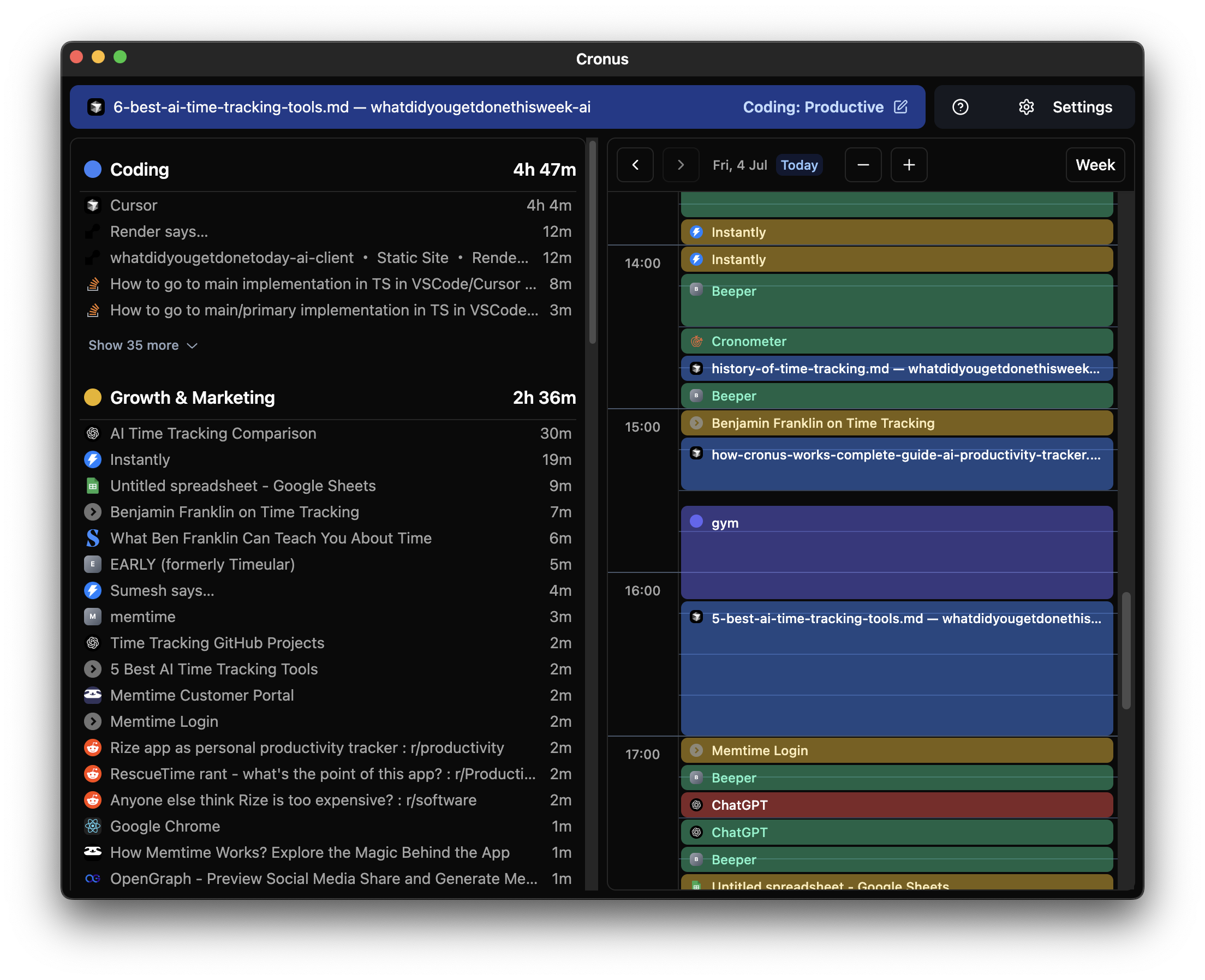
Anyone can get it. Cronus records automatically on your Mac, with no timer and nothing to log. Two weeks in each arrangement gives you your longest unbroken block, your number of context switches, and where your good hours fall, on office days versus home days.
That turns "I work better at home" into something checkable, and it sometimes goes against the person who ran it, which is the point of measuring.
$6 a month after a 21-day trial, and it never captures your screen: window titles only, redacted on your device.
One serious caution. Do not hand this to your employer, and do not use it to build a case about anyone but yourself. Personal tracking data given to a manager becomes a performance record you did not consent to, and it is used to answer questions it cannot answer. Bring a conclusion, never a log. We wrote about how to do that.
And a limit worth stating: this measures the shape of your work, not its quality. It cannot tell you whether the thinking you did in those blocks was any good, and a long unbroken block spent on the wrong thing is not a win.
If you are negotiating
Argue about which days, not whether. Mandates are rarely reversible; their scheduling usually is, and that is where most of the value sits.
Cluster the office days. Two consecutive days is one disruption to your working pattern. Two separated days is two, and it leaves no long block in either week.
Put meetings on office days and protect home days for deep work. This is the highest-value arrangement available and it is generally uncontroversial, because it gives leadership the in-person contact it wanted.
Ask what the mandate is measuring. Politely. If nobody measured before, nobody can tell whether it worked, and that is worth surfacing early rather than after a year.
Read next
- Too Many Meetings — the fragmentation problem in detail.
- Where Did My Day Go? — why the shape matters more than the hours.
- You Are Wrong About How Fast AI Makes You — the self-report problem, in full.