ADHD Waiting Mode
You have a dentist appointment at 3pm.
It is 10am. You are awake, you have a full list of things to do, and you will do none of them. You will refresh your phone, wander between rooms, maybe start something and abandon it, and wait. Five hours, gone, and you were not even doing anything enjoyable with them.
This is waiting mode. It is one of the most consistently described ADHD experiences online and one of the least discussed clinically, and it is a much bigger practical problem than it sounds, because a single 20-minute appointment can consume a working day.
What is actually happening
Three mechanisms, all well documented individually.
Working memory is occupied. Holding "3pm, dentist" in mind takes real capacity, and ADHD working memory has less of it to spare. The appointment is not sitting quietly in the background; it is running in the foreground the whole time.
Starting requires a runway you no longer have. Beginning a task is expensive with ADHD, and the calculation "is there enough time before 3pm" resolves to no far more often than the clock justifies. Five hours is objectively plenty. It does not feel like enough, because starting feels like it costs more than the remaining time.
Time is not measurable from the inside. If you cannot feel duration accurately, you cannot trust yourself to notice 2:45 arriving. So the only reliable strategy your brain finds is to keep checking, continuously, which prevents settling into anything. This is time blindness producing a rational-but-costly response.
The result: the cost of an appointment is not its length. It is everything from the moment you wake up until it ends.
Why the obvious advice fails
"Just do something in the meantime." This is the advice everyone gives and it misses the point entirely. You know that. The barrier is not information, it is that starting anything substantial feels impossible against a deadline you cannot feel.
"Set an alarm and forget about it." Closer, and insufficient on its own. The alarm handles being late; it does not release the working memory holding the appointment, which is what is actually consuming you.
"Get better at time management." Waiting mode is not poor planning. Plenty of people with excellent systems experience it.
What actually shortens it
Trust the alarm, out loud and deliberately. Set it for 15 minutes before you need to leave, then say to yourself that the alarm is now responsible for this. It sounds absurd and it is the single most effective intervention here, because it explicitly hands the monitoring job to something external. The working memory only lets go once something else has visibly taken over.
Make it an alarm you cannot ignore. Loud, or across the room, or one requiring a real action to dismiss. A quiet notification does not earn the trust, so your brain keeps monitoring anyway.
Schedule appointments at the edges of the day. This is the highest-leverage change and requires nothing from you. A 9am appointment costs an hour. The same appointment at 2pm costs the whole day. When you get a choice of slots, first or last is worth real money.
Cluster them. Three appointments on one day is one ruined day. Three appointments across three days is three ruined days. This is not obvious and it is consistently true.
Give waiting mode a designated activity. Not deep work, which will not happen. Something that occupies you without needing a long runway: tidying, a walk, laundry, a low-stakes errand. Deciding this in advance beats deciding at 10am, because deciding is itself the thing you cannot do right now.
Leave early on purpose and wait there. Waiting at the place ends the mode. Take a book. This converts five hours of nothing into one hour of reading.
How much it actually costs
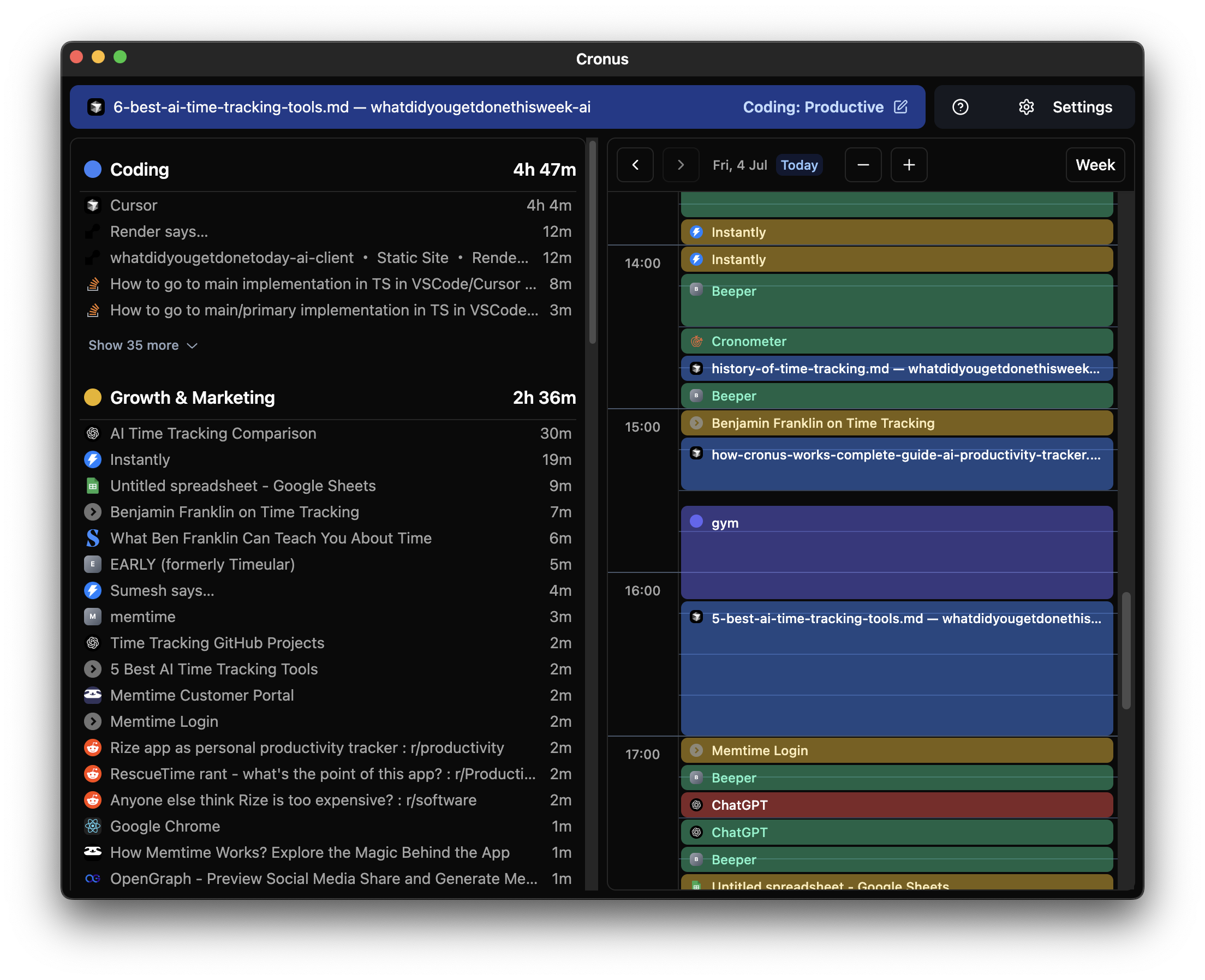
Most people underestimate this badly, because waiting mode leaves almost no memory behind. Nothing happened, so there is nothing to recall, and the day gets filed as "I had the dentist" rather than "I lost seven hours".
That underestimate is why nobody changes their scheduling.
Cronus records what actually happened on your Mac automatically, with no timer and nothing to log — which matters here specifically, because you were never going to log a morning spent doing nothing.
The number worth having is the difference between a day with a midday appointment and a day without one. When that turns out to be four or five hours rather than the twenty minutes the calendar shows, moving appointments to 9am stops being a preference and becomes obviously correct.
$6 a month after a 21-day trial, and it never captures your screen.
A limit worth stating: it will not get you out of waiting mode, and it can only see the laptop, so pacing around the kitchen registers as nothing at all. It tells you the size of the problem, which is what you need to justify changing your calendar.
If other people schedule your day
Worth asking for, and easy to grant:
- Meetings at the start or end of the day, not the middle.
- Meetings clustered into fewer days.
- Advance notice, since a meeting added at 11am for 2pm destroys the afternoon in a way a meeting booked last week does not.
You do not have to explain waiting mode to ask for any of these. "I work better with meetings grouped together" is a normal request that nobody argues with. And do not hand over tracking data as evidence — bring the conclusion, not the log.
Read next
- Time Blindness — why you cannot feel the runway.
- ADHD Paralysis — the starting problem underneath it.
- Too Many Meetings — the same cost, applied to a whole calendar.