Rejection Sensitive Dysphoria: What It Is, and What the Evidence Actually Says
Someone gives you mild feedback. Your whole day goes.
Not "you feel a bit bad." The reaction is immediate, physical, and out of proportion to the event. You know it is out of proportion while it is happening. That does not help.
Most people call this rejection sensitive dysphoria, or RSD.
Written by people who build a time tracker, not clinicians. This is about the concept and the evidence, not diagnosis or treatment.
The short version
RSD describes a real experience. Lots of people recognise it instantly.
But it is not a formal diagnosis. It is not in the DSM. It is not part of the ADHD diagnostic criteria. And the prevalence figures you see everywhere are weaker than they appear.
That does not mean it is made up. It means the label is newer and less tested than the thing it points at.
Where the term came from
Dr William Dodson coined "rejection sensitive dysphoria" in the 1990s. He defined it as extreme sensitivity to real or perceived criticism, and linked it to ADHD.
You will often see two numbers quoted:
- Roughly 99% of people with ADHD experience it
- About one third rate it as the most impairing part of their condition
Both come from Dodson's clinical practice. That is worth knowing. Clinical observation is real evidence, but it is not the same as a large population study, and figures in the 70–99% range have not been established that way.
So treat the number as an impression from one experienced clinician, not a measured rate.
What is well established
Here is where the ground is firmer.
Emotional dysregulation in ADHD is well documented. Research puts significant difficulty regulating emotion at roughly 25–45% of young people with ADHD and 30–70% of adults.
That is a big, replicated finding. RSD sits inside it as one specific pattern: dysregulation aimed at social evaluation.
So the useful framing is this. The umbrella is solid. The specific label is a clinical description that has not yet been through much formal testing.
Why the label still helps
Two reasons, and they are not small.
It names the disproportion. Before you have a word for it, the experience is just "I overreacted again." That reading produces shame, which makes the next one worse.
It separates the feeling from the fact. RSD is about how hard the reaction lands, not about whether the criticism was fair. Once you can hold those apart, you can act on the feedback without the collapse.
Neither of those requires the label to be in a diagnostic manual.
What it looks like day to day
The obvious version is the visible one: a comment lands and the day is gone.
The expensive version is quieter. It shapes what you do in advance.
- Not sending the message, because a reply might be curt
- Rewriting an email six times
- Avoiding the task where someone will judge the output
- Saying yes to things to stay liked
- Reading neutral messages as annoyed
Most of the cost is here. Not in the bad afternoons, in the constant small avoidance.
The bit that connects to time
We should be honest: we make a time tracker, and RSD is mostly not our territory. Emotional regulation is not something software fixes.
But there is one real overlap.
Avoidance is expensive and invisible. The task you keep not starting because it involves being judged does not appear anywhere. There is no record of the thing you did not do. What you see is a week that vanished, with no explanation.
Then the guilt arrives. Guilt raises the load. Higher load makes the next avoidance likelier. That loop is the same one behind ADHD paralysis.
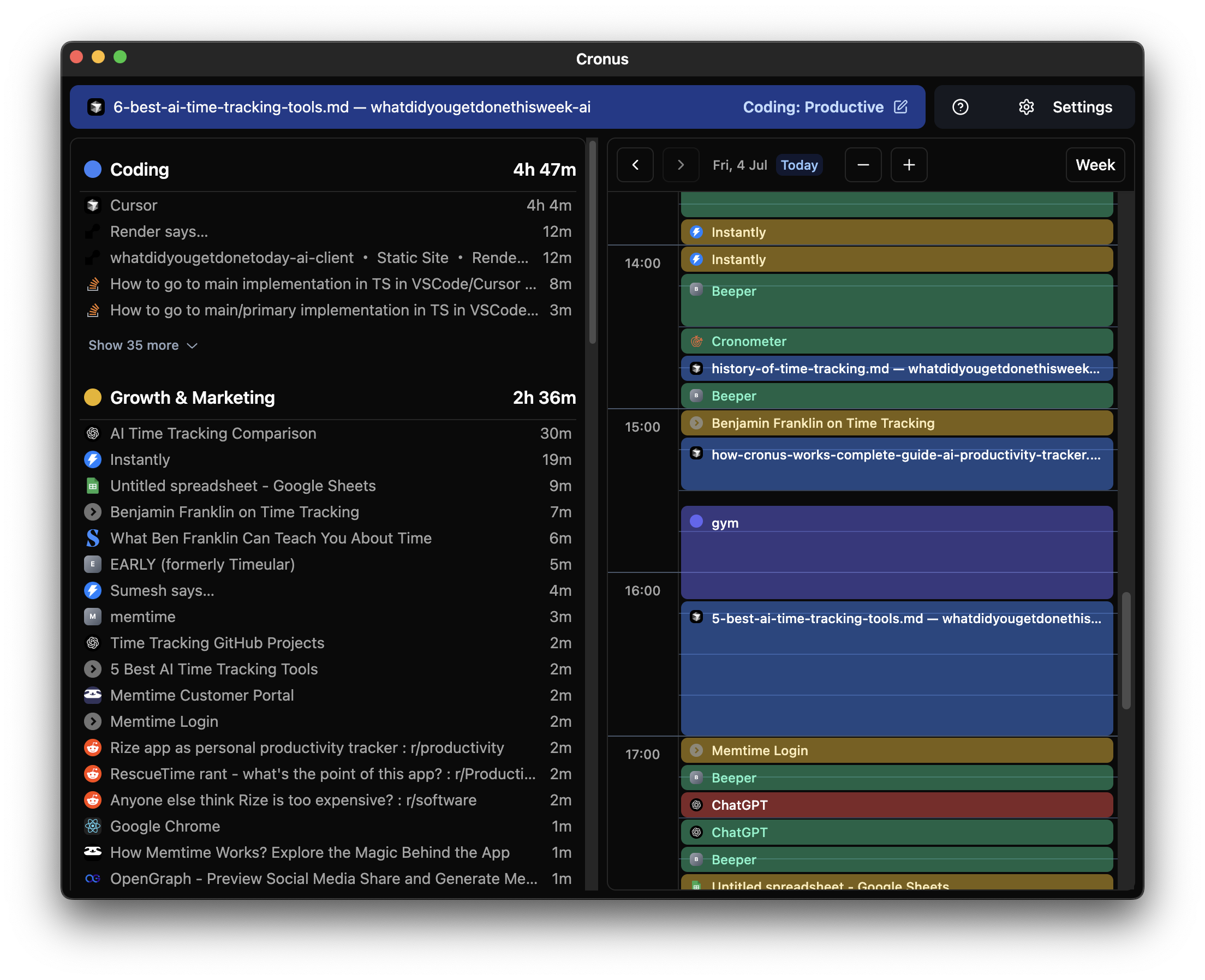
Seeing the pattern helps a little. Cronus records where your hours actually went, automatically, with no timer and nothing to log. So "I wasted the whole week" becomes something specific: the three afternoons that went sideways, and what preceded each one.
Very often the honest number is smaller than the felt one. That matters, because the felt one is what fuels the spiral.
What it will not do: it will not help you take feedback. It does not know you are upset. For the emotional side, a therapist will do more than any app, including ours.
What actually helps
Name it in the moment. "This is the reaction, not the situation." Weak on a bad day. Better than nothing.
Delay the response. Draft the reply. Send it an hour later. Most of the damage comes from responding while the reaction is at full volume.
Ask for specifics. Vague feedback is worse, because your mind fills the gap with the worst version. "Which part?" is a good question.
Notice the avoidance, not just the collapses. The dramatic afternoons are memorable. The unsent message is not, and it costs more over a year.
Get proper support if it is running your life. One third of Dodson's patients rated this the most impairing part of their ADHD. If that is you, this is a clinical matter, not a productivity one.
The honest summary
RSD is a useful name for a real thing. The evidence behind the specific label is thin, and the popular statistics come from one clinician's caseload rather than a study.
The wider finding underneath it is solid: emotional regulation is genuinely harder with ADHD, for a large share of people.
You can use the word without believing the numbers.
Sources
- Rejection Sensitivity Dysphoria in ADHD: A Case Series
- Psychology Today: Rejection Sensitivity Dysphoria, the actual research
- Neurodivergent Insights: history of the RSD term
- ADDA: rejection sensitivity in adults with ADHD
Read next
- ADHD Paralysis — the freeze that avoidance turns into.
- ADHD Burnout — what happens when the masking runs for months.
- ADHD Executive Dysfunction — where emotional regulation sits among the rest.
Find out where your week actually goes
The 5-day time audit: one short email a day, walking you through the experiments in this post. You will end the week with a real answer instead of an impression. Free, no app required, and it ends after five days.