ADHD and Reading
There is a particular experience that comes up constantly: your eyes reach the bottom of the page, and you have taken in none of it. Or you read the same paragraph four times and it still will not stick.
This is common enough with ADHD to be near-universal, and it is not a reading ability problem. Most people describing it read perfectly well.
What is actually going wrong
Working memory is the bottleneck, not decoding. Understanding a sentence means holding its beginning in mind while processing its end, and holding the paragraph while processing the sentence. ADHD working memory has less capacity to spare, so comprehension fails while the mechanical reading is fine.
Reading is low stimulation. Static text supplies almost none of the novelty, urgency or interactivity that drive engagement. The attention system finds it thin, and starts looking elsewhere.
Internal distraction, not external. The interruption usually comes from inside — a thought, a memory, an unrelated worry — and a quiet room does nothing about it.
Subvocalising competes with thinking. For many people the internal voice reading the words uses the same resource as the thoughts intruding on it.
Interest changes everything. The same person who cannot finish a page of a work document reads 400 pages of something they care about in a weekend. This is the clearest evidence that it is not a reading deficit — it is an engagement one.
Worth ruling out other things. If words move, blur or swim on the page, that is worth an optometrist and possibly a dyslexia assessment. ADHD and dyslexia co-occur frequently, and they need different support.
What actually works
Audiobooks, and take them seriously. The most effective intervention on this list, and the one people most often dismiss as cheating. It is not. If the goal is the content, the delivery format is irrelevant, and audio also allows movement, which helps considerably.
Audio plus text together. Listening while following along is more effective than either alone for a lot of people. Two channels means less spare capacity for internal interruption.
Speed it up. 1.5x or 2x is not a party trick. Faster narration leaves less room for your attention to wander off, which is why many people comprehend better at higher speed.
Read with your hands. Finger, ruler, pen. Physical tracking gives the system something to do and stops the eyes skipping.
Break the text physically. Cover everything but the current paragraph. A wall of text is discouraging before you start; one paragraph is achievable.
Read with a purpose. Skimming for a specific answer is far easier than reading for general comprehension, because it supplies a goal. Ask a question first, then read to answer it.
Take notes as you go, however scrappy. Writing forces processing and gives you an external record so you do not have to hold everything in working memory.
Move. Walking while listening, or standing while reading. Sitting still is a cost you pay before any of the actual work.
Read the interesting thing first. Not the beginning. Nothing requires reading a book in order, and momentum is worth more than sequence.
Accept abandoning books. Finishing something you are not engaging with costs weeks and teaches you that reading is a chore. Three abandoned books and one absorbing one is a better month than one grim completion.
For work reading you cannot avoid
Different problem, since interest is not available.
Convert it to audio. macOS and iOS will read any document or web page aloud. This alone makes long documents survivable.
Summarise first, then read. Knowing the shape before you start means working memory is not also building the structure.
Read it to answer a question. "What does this change for me?" gives the attention system a target.
Set a very short session. Fifteen minutes of real reading beats two hours of eyes-on-page.
Read at your good hours. Most people have two or three hours a day when demanding reading is genuinely possible, and use them for email instead.
Finding your good hours
That last point is worth more than any technique on this page, and almost nobody knows their own answer.
Reading is one of the most cognitively demanding things most people do, so it is the least forgiving of being scheduled badly. Done in your worst hour it is genuinely impossible; done in your best it may be fine.
Most people guess wrong about when their good hours are, because they remember the days that matched their self-image rather than the average.
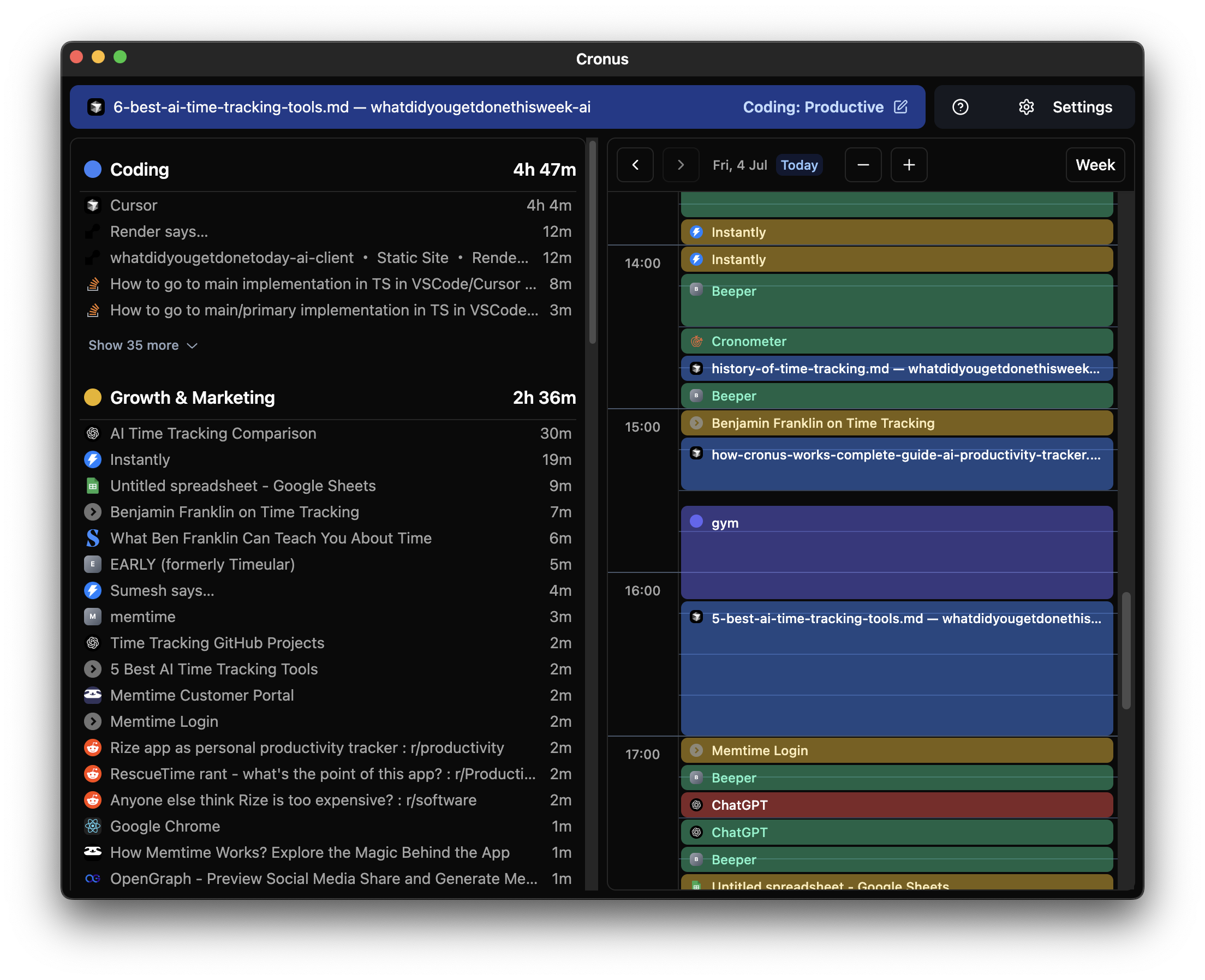
Cronus records automatically on your Mac, with no timer and nothing to log. After a couple of weeks you can see when you actually sustain attention and when you do not, and move demanding reading into those hours rather than fighting for it at 4pm.
$6 a month after a 21-day trial, and it never captures your screen: window titles only, redacted on your device.
Honest limits. It cannot tell whether you understood anything — a document open for forty minutes looks identical whether you absorbed it or reread one paragraph twelve times. And it will not see a paper book at all. It tells you when to schedule the reading, not whether it worked.
On not feeling bad about it
A large amount of ADHD reading shame comes from an assumption that reading books is the legitimate way to take in information, and everything else is a lesser substitute.
There is no good reason to believe that. Audiobooks, podcasts, video, summaries and conversations all deliver content, and the research on audio versus print comprehension finds far less difference than the cultural hierarchy implies.
If the goal is knowing things, use whatever gets it in. If the goal is the specific pleasure of reading a physical book, that is a different goal, and it deserves your good hours rather than the end of a tired evening.
Read next
- ADHD Focus Music — including why lyrics wreck verbal work.
- The Best Apps for ADHD Adults — capture and text-to-speech tools.
- Where Did My Day Go? — finding the hours worth protecting.