ADHD Focus Music
Music is one of the few ADHD interventions that is free, instant, and carries no downside worth mentioning. It is also surrounded by more confident marketing than the evidence supports.
Here is what actually holds up, what does not, and what to try.
Why it helps at all
Two mechanisms, both plausible and reasonably supported.
Masking. Steady sound covers unpredictable sound. It is not the noise that breaks concentration so much as unexpected noise — a door, a conversation starting, a notification across the room. Continuous audio removes the surprise, and this is probably the larger effect.
Optimal stimulation. The dominant account of ADHD attention is that it is under-stimulated for boring tasks, and that a bit of extra input helps reach a workable level. This is why people with ADHD can often work better with background input while others find it distracting.
Which mechanism dominates for you determines what to play, and it is worth knowing which you are: if noise is the problem, anything steady works. If understimulation is the problem, the music itself needs to carry some energy.
What the evidence actually shows
Being honest about this is more useful than a confident recommendation.
Background music has small, inconsistent effects on cognitive performance, and the direction depends on the task, the person and the music. Effects on complex verbal work are often negative. There is no result robust enough to justify "music makes you focus".
White and brown noise show more promise for ADHD specifically. Several studies have found white noise improving performance on attention tasks in children and adults with ADHD, while sometimes worsening it for people without. This fits the stimulation account, and it is the closest thing to a genuinely ADHD-specific finding here. The studies are small, so treat it as promising rather than established.
Binaural beats are the weakest claim with the strongest marketing. The theory is that slightly different frequencies in each ear entrain brainwaves. Studies are small, mixed and often poorly controlled, and the better-designed ones tend to find little. Some people report real benefit, which may be placebo, may be the masking effect that any steady audio provides, and may not matter much either way if it works for you.
Lyrics are the one clear finding. Language competes with language. For reading, writing or anything verbal, lyrics measurably interfere. This is the most reliable practical rule on this page.
"Music for productivity" services have thin published evidence. Brain.fm has published some work on its own product; independent replication is limited. That does not make it useless — the subjective response is strong for many people — but treat the claims as marketing.
What to actually try
Brown noise is the one to try first, and it is currently the most popular in ADHD communities for good reason. Deeper and less harsh than white noise, less fatiguing over hours. Free on YouTube and most streaming services.
Video game soundtracks are unusually good at this and rarely mentioned. They are engineered to hold attention without capturing it — that is literally the design brief, since they must not distract from play. No lyrics, no sudden changes, no big emotional swings. Try Minecraft, Stardew Valley, Civilization or any racing game.
Lo-fi hip hop for the same reasons: repetitive, instrumental, no dynamic surprises.
One song on repeat. Sounds unbearable and works remarkably well for many people. A track you know completely stops being information and becomes texture.
Classical or ambient, though beware anything with dramatic dynamics. Ambient and minimalism work better than romantic-era pieces.
Silence with earplugs or noise-cancelling headphones, which is the right answer for a meaningful minority and gets skipped because it is not a product.
What to avoid
- Lyrics during verbal work. The one firm rule.
- Anything new. Unfamiliar music demands attention, because novelty is the thing your attention system is most drawn to. Familiarity is the feature.
- Algorithmic playlists that keep changing. Every new track is a small interruption.
- Music you love. Counterintuitive and consistent: music you have strong feelings about pulls attention toward itself.
Match the sound to the task
A useful rule that most advice omits:
Boring, mechanical work — more stimulation. Faster tempo, more energy. Music can carry a task with no inherent interest.
Demanding, verbal work — less. Brown noise or silence. This is where music most often hurts and where people most often assume it is helping.
Starting something — this is where music is most valuable, and it is worth being deliberate about it. A specific album or track used only for work becomes a cue over time, and cues do real work when task initiation is the obstacle.
Whether it is actually working
Here is the awkward part: feeling focused and being focused come apart, badly.
In a randomised controlled trial, experienced developers estimated a tool had made them 20% faster on real tasks from their own repositories. They were 19% slower. A forty percentage point error about work they had just completed. The full study.
So "I focus so much better with this playlist" is a report from a faculty with a demonstrated error range wide enough to invert the answer. Music that feels great might be costing you, and given the research showing background music harming complex verbal performance, that is not hypothetical.
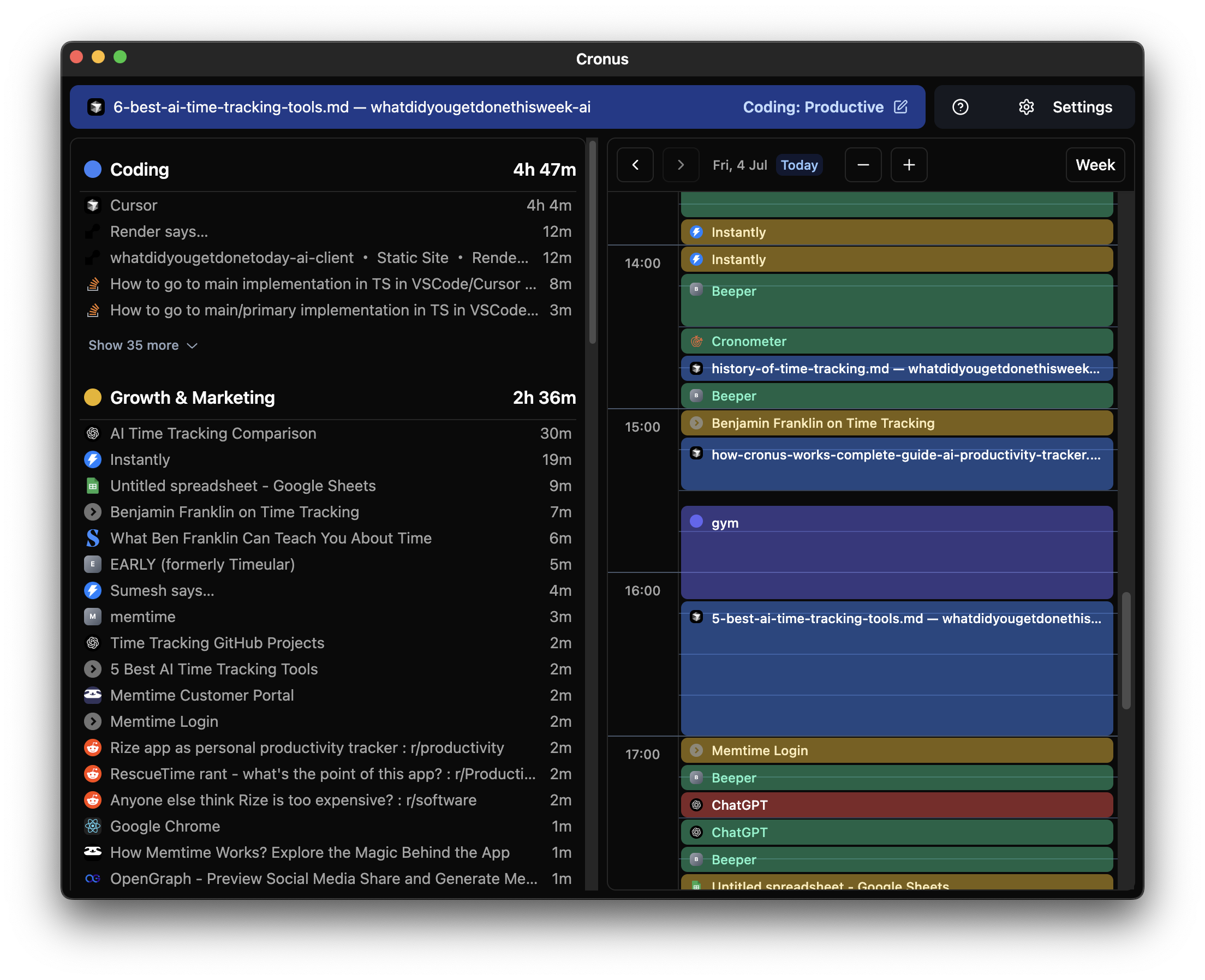
Testing it is easy and almost nobody does. Cronus records automatically on your Mac, with no timer and nothing to log. Two weeks with, two weeks without, then compare the numbers that matter: longest unbroken block, and time on the work you meant to do.
$6 a month after a 21-day trial, and it never captures your screen.
Fair limit: it measures the shape of your work, not its quality. A long block of bad writing looks the same as a long block of good writing. And if brown noise makes a difficult hour bearable, that is worth something whether or not it shows up in the numbers.
Read next
- How to Beat Distractions at Work — the environment side.
- The Best Apps for ADHD Adults — including the audio ones.
- The Flowtime Technique — working out your real attention span.