ADHD Forgetfulness: It Is Usually Working Memory, Not Memory
You can recall a conversation from six years ago in detail.
You cannot recall why you walked into the kitchen.
Those are not the same system. Understanding which one is struggling changes what actually helps.
Written by people who build a time tracker, not clinicians. About mechanism and practical fixes, not diagnosis.
Two different systems
Long-term memory stores things. For most people with ADHD, it works fine. Sometimes better than fine.
Working memory holds information live while you use it. It is small, it is temporary, and it is the one under strain.
Think of it as desk space rather than filing cabinet. The cabinet is large and organised. The desk is small, and anything on it falls off when something new lands.
Working memory difficulties are well documented in ADHD, and they sit among the executive functions rather than among memory problems as most people picture them.
What that explains
Nearly every "forgetful" moment is a desk problem, not a cabinet problem:
- Walking into a room and losing the reason. The reason was on the desk. The corridor knocked it off.
- Forgetting the start of a sentence mid-sentence.
- Losing an idea while waiting for someone to finish speaking.
- Reading a paragraph three times without retaining it.
- Forgetting an errand while doing a different errand.
None of these are storage failures. The information never got to storage.
Why the usual advice misses
"Concentrate harder." Concentration does not increase desk size. Under load, holding on harder makes it worse.
"Use a to-do list." Right idea, usually implemented wrong. A list you have to remember to check is still leaning on the impaired system.
"Repeat it to yourself." Rehearsal occupies the desk. Now you are holding the thing and the act of holding it.
What actually works
One principle: get things off the desk and somewhere external, immediately.
Capture in under three seconds. One place, always to hand. Notes app, paper, whatever. The requirement is speed, not organisation. If capture takes longer than the thought lasts, you lose it.
Externalise the sequence. For multi-step tasks, write the steps before starting. Not for discipline. So you are not carrying the sequence while executing it.
Make the cue live in the world. Put the thing you need to take by the door. Objects are better reminders than intentions, because they do not need to be remembered.
Close loops immediately or write them down. Anything you promise to do later either happens now or gets recorded. Nothing lives in your head.
Reduce parallel load. Most working memory failures happen with several things in flight. Fewer active threads is worth more than any technique.
Confirm decisions in writing. After a meeting, write what was agreed. Not because you were not listening. Because reconstructing later is unreliable, and everyone benefits.
The one that costs most
Forgetting what you were doing is different from forgetting facts, and it is much more expensive.
You switch away for thirty seconds. You come back and the thread is gone. Rebuilding it costs minutes, and the rebuild is invisible, so nobody counts it.
Over a fragmented day, that is a large number that never appears anywhere.
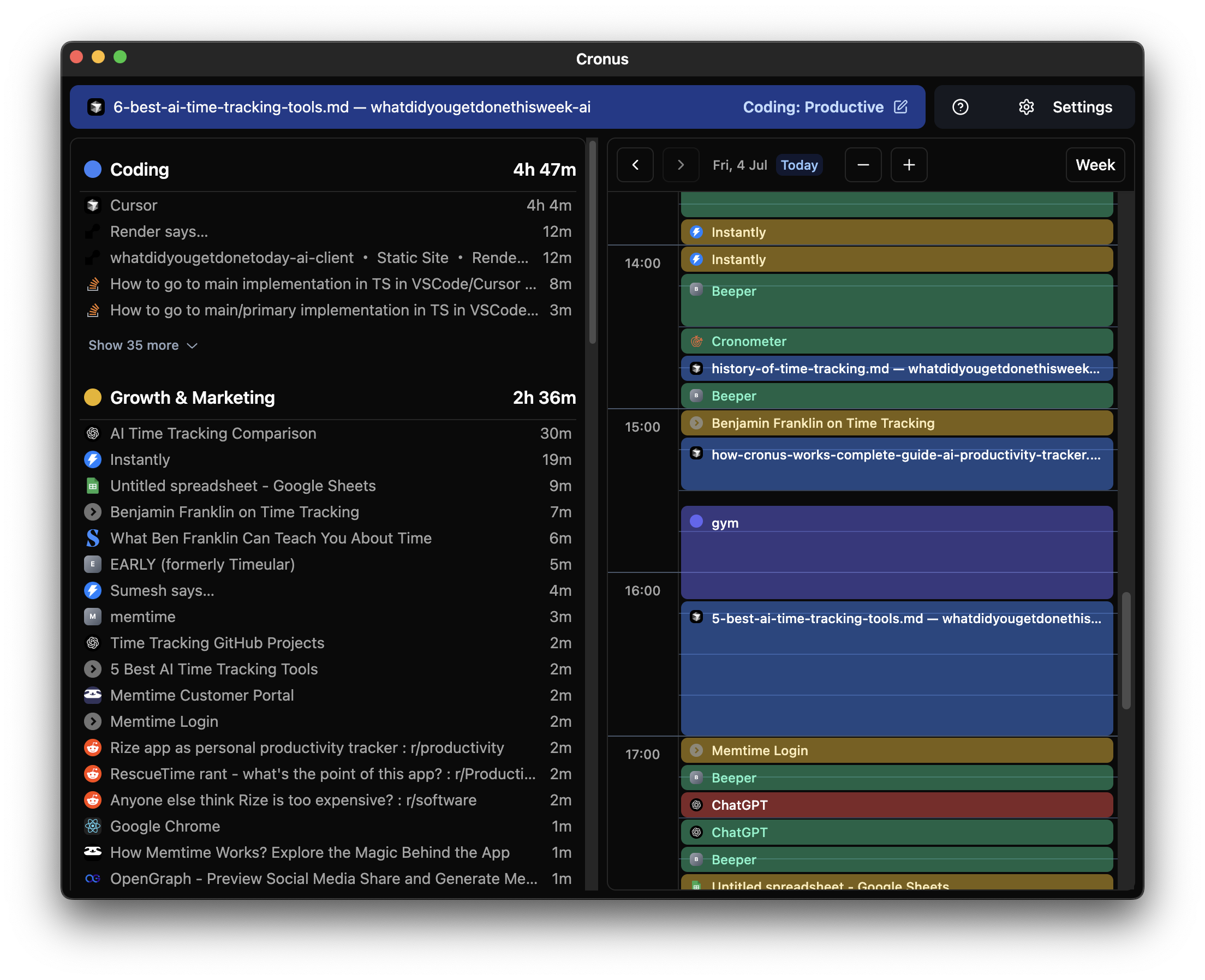
This is where Cronus is useful. It records what you were in, automatically, with nothing to log. So the number of context switches in a day is a fact rather than an impression, and so is how long you actually sustained one thing.
Most people are startled by the switch count. It is usually far higher than they would guess, and it explains days that felt full and produced little.
Where it does not help: it will not remember anything for you. For capture, a notes app and the three-second rule will do more.
The reframe
You are not bad at remembering. Your desk is small.
So stop trying to hold more, and start putting things down faster. Every fix worth having is a version of that.
Read next
- ADHD Executive Dysfunction — where working memory sits among the seven functions.
- Where Did My Day Go? — what fragmentation actually costs.
- ADHD Time Blindness — the other function that fails quietly.
Find out where your week actually goes
The 5-day time audit: one short email a day, walking you through the experiments in this post. You will end the week with a real answer instead of an impression. Free, no app required, and it ends after five days.