ADHD and Cleaning
Cleaning is one of the most reliable sources of ADHD shame, and one of the least well explained.
The usual framing — you need better habits, more discipline, a routine — misses what is actually going wrong. So the advice fails, and each failure adds evidence to the story that you are a person who cannot keep their home in order.
Why it is genuinely hard
"Clean the kitchen" is not one task. It is roughly forty, with dependencies. Clear the counter, but first empty the sink, but first empty the dishwasher, but first put away the clean things, but first there is nowhere to put them. Executive function is what breaks a goal into an ordered sequence, and that is precisely the impaired function. The task is not hard; the decomposition is.
There is no first step and no end state. Cleaning is never finished, so there is no completion signal, and completion is what makes anything feel worth doing.
It is low stimulation and low urgency. Two of the four things that drive ADHD engagement are simply absent. Nothing bad happens today if the dishes wait.
Out of sight is out of mind. The pile stops registering after a week. Genuinely stops — visitors see it, you do not. Our post on object permanence covers the mechanism.
Perfectionism blocks the start. If it cannot be done properly, why start. So a two-minute tidy never happens because it would not be a real clean.
The mess itself is overwhelming. Visual clutter consumes attention, so a messy room makes it harder to do anything about the messy room. This is a feedback loop, not a character flaw.
The doom pile
A doom pile is the accumulated stack of things without a decided home. Post, chargers, receipts, a jumper, three unopened parcels. Sometimes shovelled into a box — a doom box — when someone is visiting.
The name comes from DOOM: Didn't Organise, Only Moved. Which is exactly what it is.
Why they form: each item requires a decision, decisions are the expensive part, and "put it here for now" defers all of them at once. The pile is not laziness, it is deferred decision-making, and it grows because every added item makes the eventual sorting job larger and therefore more avoidable.
How to actually clear one. Not by sorting it properly.
- Bin bag first. Rubbish only, nothing else. Usually removes a third of it and requires no decisions.
- Then obvious homes. Only things with an existing place. Do not create new places.
- Then one box for the undecided. Whatever is left, in a box, date on it. If you have not needed anything from it in three months, most of it can go.
- Never sort it in one sitting. Fifteen minutes is the unit. A doom pile approached as a project does not get approached.
The real fix is upstream: more things need obvious homes, and homes need to be reachable in one action. Anything that requires opening a cupboard, moving something and finding a box will not get put away.
What actually works
Lower the standard, deliberately. A partly clean kitchen is not a failure. The all-or-nothing framing is the single biggest obstacle, and "wipe one counter" is a legitimate outcome.
Do one visible surface. The visual relief is disproportionate, and it makes the next thing easier.
Set a timer for fifteen minutes and stop when it goes. Stopping matters as much as starting: it makes the next session feel survivable.
Never leave a room empty-handed. Cheap, cumulative, requires no decision.
Body double it. A person in the room or on a call works better for cleaning than for almost anything else, and works even when they are doing their own thing.
Put on something absorbing. A podcast or audiobook supplies the stimulation the task lacks. This is the closest thing to a reliable trick here.
Reduce the number of objects. Fewer things is less to organise, and it is a permanent fix rather than a recurring effort. The most effective cleaning strategy is owning less.
Make it visible. Open shelves, clear boxes, hooks instead of hangers. Every closed container is somewhere things vanish.
Pay someone if you can. Genuinely: if a cleaner is affordable, that is a reasonable use of money and not a moral failure. The ADHD tax is often larger than a cleaner would cost.
The time part
One thing worth knowing, and it is the reason this post exists on a time tracking site.
People wildly overestimate how long household tasks take. The dishes feel like an hour and take eleven minutes. Not sometimes — usually. The dread is calibrated to the decomposition problem rather than the actual work, and the anticipated cost is what prevents starting.
The fix is embarrassingly simple: time it once. Not with an app, with your phone. Most people are shocked, and the shock is durable. Knowing the kitchen takes fourteen minutes changes the calculation permanently.
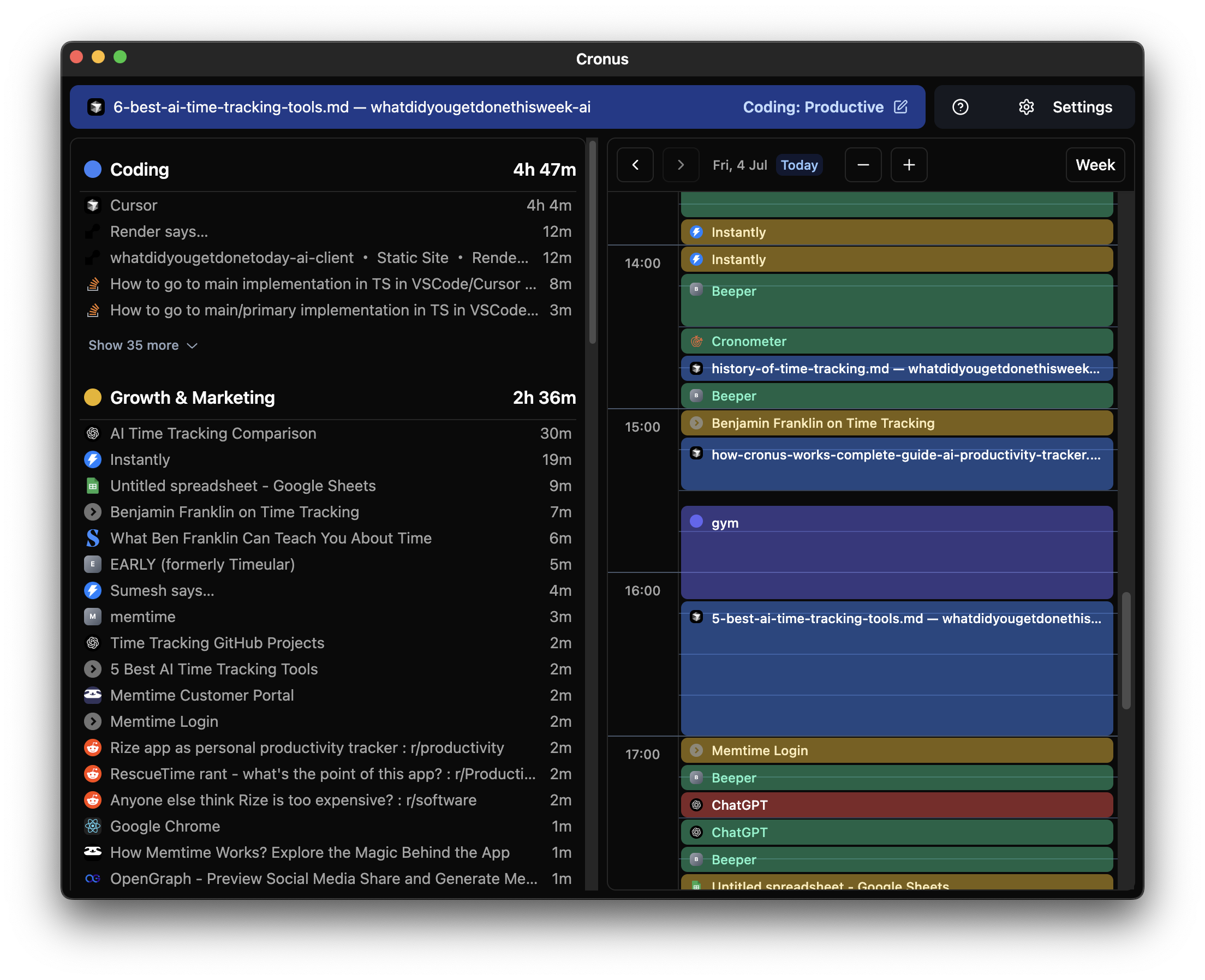
For desk work, Cronus does this automatically on your Mac, with no timer and nothing to log, so you accumulate real estimates instead of hopeful ones. It cannot see your kitchen — nothing on your laptop can — so for household tasks the answer is genuinely a phone timer and thirty seconds of curiosity.
That is the honest version. We are not going to pretend a Mac app helps you clean.
$6 a month after a 21-day trial if the desk-work version is useful to you.
The part that matters
The mess is not a moral fact about you. It is what happens when a task requiring heavy executive function meets an executive function system that is unreliable, in an environment with no urgency and no completion signal.
Every technique above works by removing decisions, adding stimulation, or lowering the bar. None works by trying harder, because trying harder is the resource that is short.
Read next
- ADHD Paralysis — the initiation problem, in general form.
- ADHD and Object Permanence — why the pile stops registering.
- Body Doubling — the most effective tool for exactly this.