ADHD and Caffeine
Two things bring people to this question. Either caffeine makes you sleepy, which seems backwards, or you are wondering whether coffee can substitute for medication.
The short answers: the sleepiness is real and has a plausible explanation, and no, it is not a substitute — but it is not nothing either.
This is not medical advice, and caffeine interacts with ADHD medication. If you take stimulants, the interaction is worth an actual conversation with your prescriber rather than a blog post.
Why it can be calming
Caffeine is a stimulant, so a sedating effect looks paradoxical. Two accounts, both plausible.
The optimal stimulation account. The dominant model of ADHD attention holds that the system is under-aroused for tasks lacking novelty or urgency, and that understimulation produces restlessness — the fidgeting and seeking behaviour that looks like excess energy is arguably the system trying to generate input. Add stimulation and the seeking stops. The calm is the restlessness resolving, not sedation.
This is the same logic behind stimulant medication treating hyperactivity, which is equally counterintuitive until you look at it this way.
The dopamine account. Caffeine's main action is blocking adenosine, which indirectly increases dopamine signalling. ADHD involves differences in dopamine transmission, so the effect may land differently. This is a reasonable mechanism, and the evidence for it specifically explaining the calming effect is thin.
Worth being straight: the "caffeine calms ADHD" claim is much more established as lived experience than as research finding. It is reported very consistently. It has not been well studied.
Does it actually help attention?
Modestly, and much less than the internet suggests.
Caffeine improves alertness and vigilance in most people. That is one of the better-replicated findings in psychopharmacology, and it is not ADHD-specific.
Evidence for caffeine treating ADHD symptoms is weak. Some small and mostly old studies suggest modest effects on attention; the results are inconsistent and the effect sizes are well below stimulant medication. Reviews generally conclude it is not a viable treatment.
It does not do what medication does. Methylphenidate and amphetamines act on dopamine and noradrenaline directly and produce effects on executive function that caffeine does not approach. Anyone framing coffee as a natural alternative is either misinformed or selling something.
Useful framing: caffeine is a mild tool for alertness. It is not a treatment, and treating it as one usually means escalating the dose until the sleep cost exceeds any benefit.
The sleep problem
This is the part that matters most and gets discussed least.
Caffeine's half-life is about five to six hours, meaning a 3pm coffee still has a quarter of its caffeine active at bedtime. It reduces deep sleep even when you fall asleep fine, and you will not notice this happening.
That matters more with ADHD than without, because sleep deprivation produces symptoms nearly indistinguishable from ADHD itself: poor attention, worse working memory, emotional dysregulation, impaired executive function.
So the common loop: caffeine to cope with tiredness, worse sleep, worse symptoms tomorrow, more caffeine. It feels like it is helping at every step, and the net effect over a week can easily be negative.
Given that people with ADHD already have elevated rates of sleep problems, this is not a small consideration.
Practical guidance
Set a cutoff, and make it earlier than feels necessary. Eight hours before bed is the conservative version; 2pm for a 10pm bedtime. This single change does more than any dosing strategy.
Watch the total, not the cups. A large coffee-shop coffee can be several times a home cup. Energy drinks and pre-workout supplements are frequently the actual source when someone cannot work out why sleep is bad.
Do not stack it with medication without asking. Both are stimulants and the combination can produce anxiety, elevated heart rate and worse sleep. Genuinely worth raising with your prescriber.
Watch for the anxiety threshold. Caffeine reliably increases anxiety above a certain dose, and that threshold is often lower than expected. If you are anxious and caffeinated, try reducing before concluding anything about the anxiety.
Try it as a task tool rather than a routine. Coffee before a specific piece of demanding work is more useful than four cups spread through a day, which mostly maintains a tolerance.
Expect a rough week if you cut down. Withdrawal headaches and fatigue are real and pass in about a week. Taper rather than stopping abruptly.
Working out whether it helps you
Here is the difficulty: caffeine's most reliable effect is making you feel more alert, and feeling alert is not the same as working better.
In a randomised controlled trial, experienced developers estimated a tool had made them 20% faster on real tasks. They were 19% slower — a forty percentage point error about work they had just completed. The study. Subjective reports about your own performance are not reliable evidence, and caffeine acts directly on the subjective part.
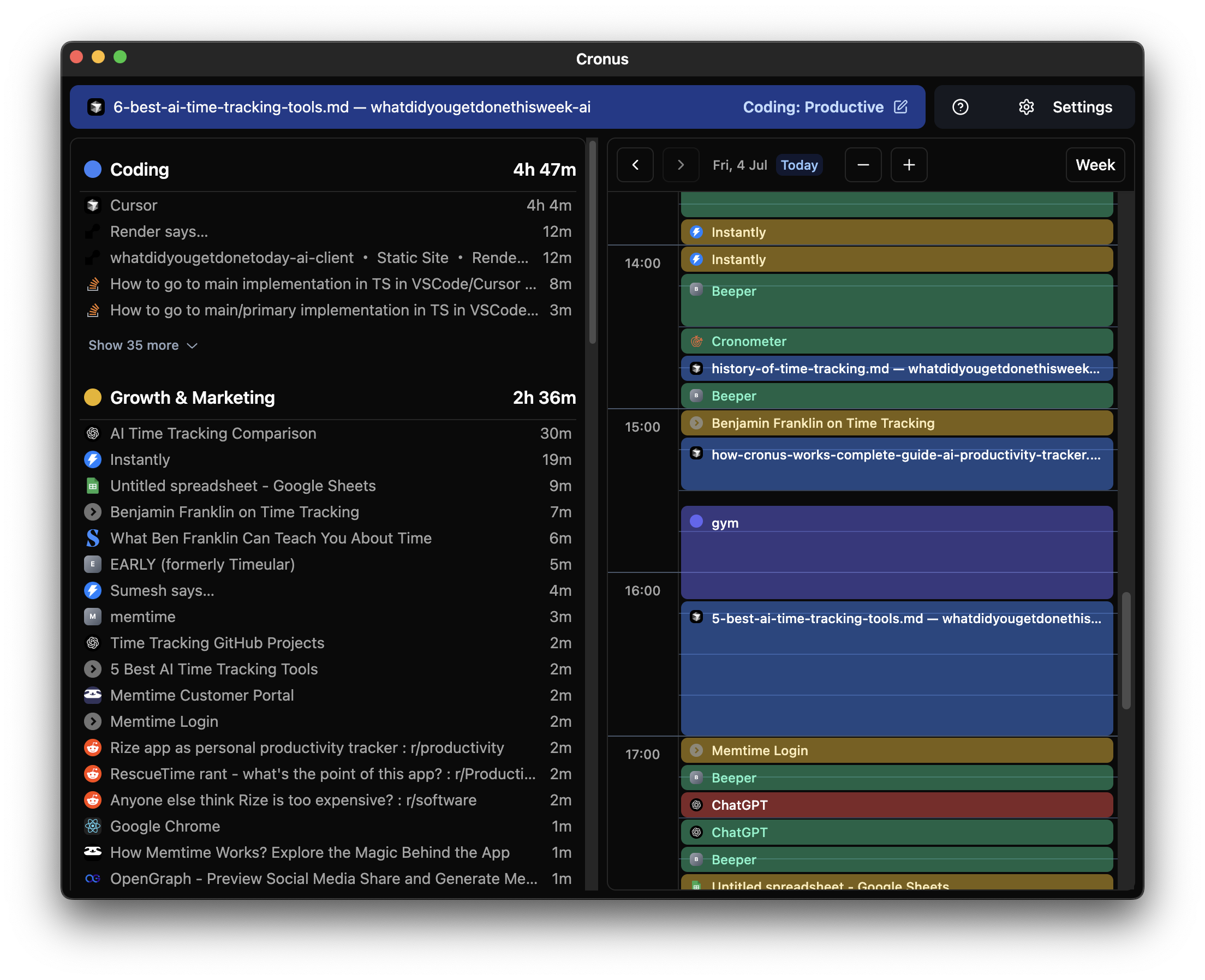
Testing it costs nothing but attention. Cronus records automatically on your Mac, with no timer and nothing to log. Two weeks at your normal intake, two weeks with an earlier cutoff, then compare longest unbroken block and time on intended work.
$6 a month after a 21-day trial, and it never captures your screen.
Clear limits. It cannot measure sleep, mood or anxiety, which is where most of caffeine's real effect lands. Pair it with a one-line sleep note each morning and you will learn more than either gives you alone.
Read next
- ADHD and Sleep Problems — the upstream issue.
- ADHD Focus Music — another mild stimulation lever, similar caveats.
- The Best Apps for ADHD Adults — what has better evidence behind it.