Work Log Template
Three templates below, in plain text so you can paste them into anything. Then the part most template pages leave out: why logs get abandoned, and which of these survives.
1. Daily work log
The simplest useful format. One line per item, written as you go rather than reconstructed at 6pm.
## 2026-08-12

09:15  Standup
09:40  Billing migration - schema changes
11:20  Interrupted: prod alert, ~25 min
12:05  Billing migration - resumed, tests passing
13:00  Lunch
13:45  Review: Sam's PR
14:30  Meeting: roadmap Q4
15:45  Email + admin
16:30  Billing migration - deploy prep

Done:    schema migration merged, PR reviewed
Blocked: waiting on infra for staging access
Tomorrow: deploy, then start the reconciliation job
The three lines at the bottom are the valuable part. Done, blocked, tomorrow. If you keep nothing else, keep those — they take ninety seconds and they are what makes the log worth rereading.
2. Project log
For tracking one piece of work across weeks. Table format, one row per session.
| Date | Time | Phase | What happened | Next |
|---|---|---|---|---|
| 4 Aug | 2h10 | Design | Settled on event-sourced approach | Write ADR |
| 5 Aug | 0h45 | Design | ADR drafted, circulated | Wait for review |
| 7 Aug | 3h30 | Build | Core writer done, tests green | Reader side |
| 11 Aug | 1h15 | Build | Blocked on staging access | Chase infra |
Plain text version:
2026-08-04 | 2h10 | Design | Settled on event-sourced approach | Write ADR
2026-08-05 | 0h45 | Design | ADR drafted, circulated       | Wait for review
2026-08-07 | 3h30 | Build  | Core writer done, tests green | Reader side
Track the blocked time separately. It is usually the largest category on any real project and the one nobody records, which is why post-mortems conclude the work was underestimated when the truth is it spent three weeks waiting.
3. Billable log
If the log becomes an invoice, it needs a client, a rate basis and a description someone will accept.
Date        Client      Project     Hours  Billable  Description
2026-08-12  Acme        Redesign    2.25   Y         Homepage revisions, round 2
2026-08-12  Acme        Redesign    0.50   N         Scope call
2026-08-12  Internal    Admin       0.75   N         Invoicing, expenses
Two rules that matter more than the format. Log the non-billable rows too — they are how you find out your effective hourly rate is 55% of your headline rate. And round to nearest, never up: ten entries a day rounded up adds over an hour nobody worked, which on a client invoice is a real problem. The rounding rules are here.
Why logs get abandoned
Every one of these works. Almost nobody keeps one past three weeks, and it is worth understanding why before you conclude anything about yourself.
They require an action at the moment you switch tasks. That is precisely when you have the least attention to spare — you are already mentally in the next thing. The cost is small and it lands at the worst possible instant.
The bad days produce no entries. A calm Tuesday gets logged. A chaotic Thursday with nine interruptions does not, because there was no moment to write anything down. So the log covers your good days and misses your bad ones.
That makes the record worse than nothing. It looks like data, so you trust it, and it systematically flatters you — the fragmentation, the interruptions and the waiting are exactly what is missing.
Reconstruction at 6pm does not fix it. Memory smooths a day into something more purposeful than it was. In a randomised controlled trial, experienced developers estimated a tool had made them 20% faster on real tasks; they were 19% slower — a forty point error about work they had just finished. The study.
None of this is a discipline problem. It is a design problem with any manual log, and it fails hardest exactly when the record would have been most useful.
Which one to actually use
If you need a defensible record — billing, legal, client work — use the billable log and accept the overhead. A human has to stand behind each line, so it has to be manual. Reconciling it daily rather than weekly is the only thing that keeps it accurate.
If you want the "done, blocked, tomorrow" benefit, use the daily log but write only those three lines. Ninety seconds at the end of the day, no timestamps, no switching cost. This is the version that survives, because it asks nothing of you during the day.
If you want to know where the time actually went, do not use a manual log at all.
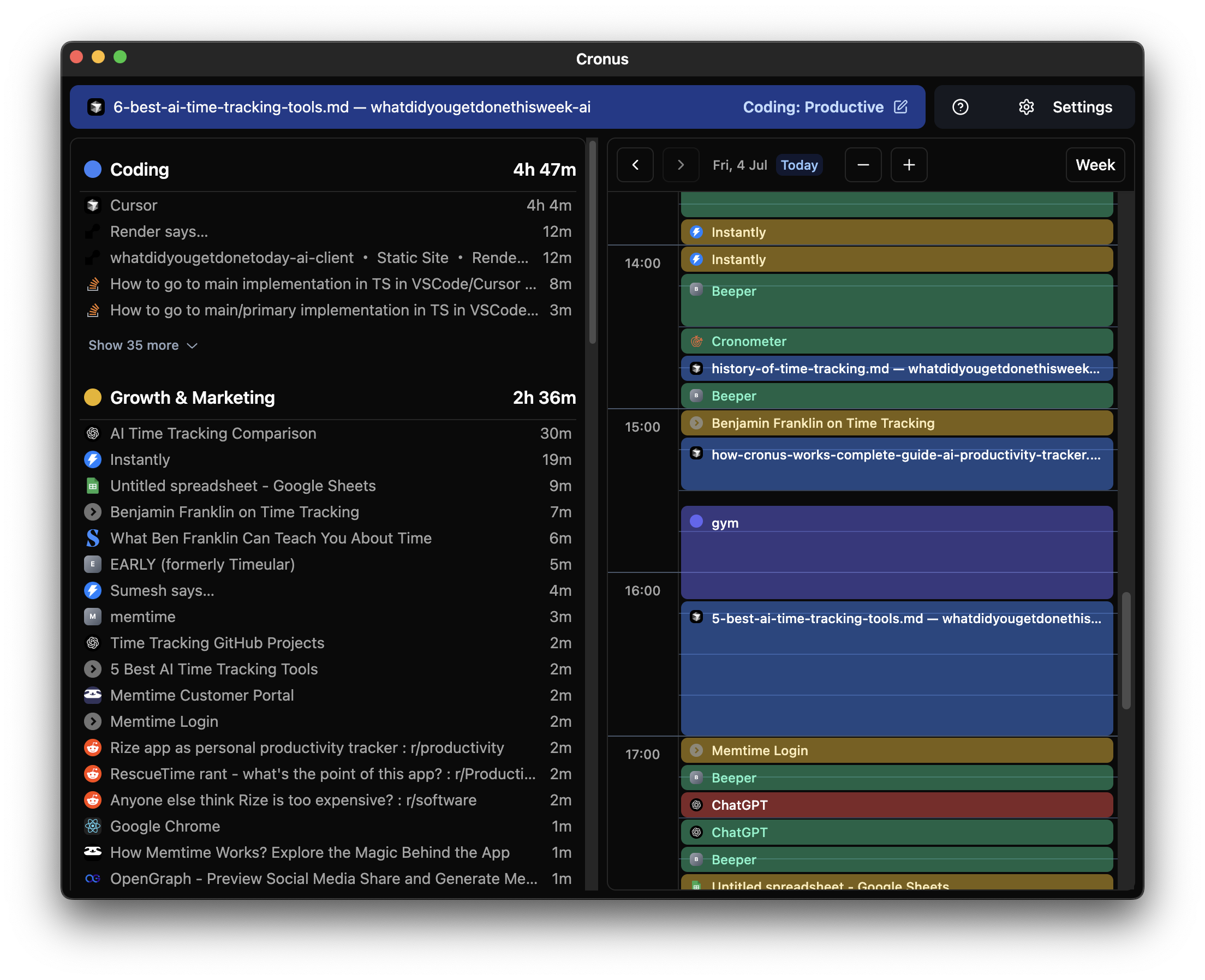
Cronus records it automatically on your Mac — no timer, nothing to log, nothing to remember at the switch. Which matters for the specific reason above: the chaotic days produce a complete record instead of a gap.
The honest division of labour is that a log and a tracker do different jobs. A log captures what you decided and why. A tracker captures where the time went. The first needs a human; the second does not, and pretending one tool does both is how people end up with a log that covers half their week.
$6 a month after a 21-day trial, and it never captures your screen: window titles only, with sensitive information redacted on your device.
It will not produce an invoice. No rates, no client reports, nothing you could send anyone. For billing, use the template above alongside it, or a proper billing tool — the options are here.
Read next
- Time Tracking Spreadsheet — the spreadsheet version and its limits.
- How to Do a Time Audit — a structured one-week version.
- 15-Minute Increments — conversion chart and rounding rules.