AI Gave You Back Six Hours a Week. Where Did They Go?
There is a genre of statistic that has been everywhere for two years now. Knowledge workers using AI report recovering something like six hours a week. Senior people report ten or twelve. Support teams report eight or nine.
Set aside for a moment whether those numbers are real. (They are self-reported, and self-reports about time are wrong by about forty percentage points, so treat them as a ceiling rather than a measurement.)
Assume the hours are real. Six a week. Roughly three hundred a year, which is seven and a half working weeks.
Here is the question almost nobody is asking: what happened to them?
Not "what could you do with them." What did you actually do with them, last week, in real hours you actually lived.
Almost nobody can answer. That is not because the hours vanished into nothing. It is because a recovered hour does not announce itself.
Why saved time is invisible
When you save an hour, you do not receive an hour. Nothing arrives. There is no notification.
What happens is that a task which used to take ninety minutes takes thirty, and then the next forty-five minutes are just... the next forty-five minutes. They fill with whatever the ambient pressure of your working day fills with. Slack. Another ticket. The tab you had open. A meeting that expands because there is now room for it.
Three things reliably eat recovered time, and none of them feel like anything at the moment they happen.
1. The work expands. Parkinson's law is not a joke about bureaucracies, it is a description of how attention behaves when a container has slack in it. The task that got faster grows to reoccupy its slot, with more polish, more iterations, more prompts.
2. Volume substitutes for depth. METR's 2026 survey found technical workers reporting a median 3x speedup but only 1.4x to 2x more value, and the researchers are explicit about one mechanism: people drift toward tasks AI does quickly, whether or not those tasks are worth doing. You did not save an hour, you did three more cheap things.
3. Fragmentation absorbs the rest. Ninety uninterrupted minutes is one block. Thirty minutes of work plus an hour of scattered availability is not the same hour reallocated, it is the same hour dissolved. Recovered time arrives as slack rather than as a block, and slack is exactly what interruptions colonize first.
The compounding problem
Because none of that is visible, none of it is decided.
An hour you never noticed receiving is an hour you never chose how to spend. And the mechanisms above are not neutral defaults, they systematically favour the shallow: whatever is loudest, whatever is nearest, whatever is easiest to start.
So the plausible honest answer to "where did the six hours go" is: into more, smaller, faster work, more thinly spread, that you cannot recall a week later.
Which is a strange outcome for a productivity revolution. The tools worked. The hours were real. And the week does not feel any more spacious, because the recovered time was reabsorbed by the same system that was already consuming your attention before AI showed up.
The only way to find out
You cannot introspect this. The whole problem is that the change is invisible and gradual, and your memory of last week is reliably wrong in the flattering direction.
The only way to know what happened to your recovered hours is to have been measuring on both sides of the change.
Which is worth saying plainly, because it has an implication people do not like: if you are not tracking now, you cannot answer this question later either. The comparison you would need in six months requires a baseline you are not collecting today.
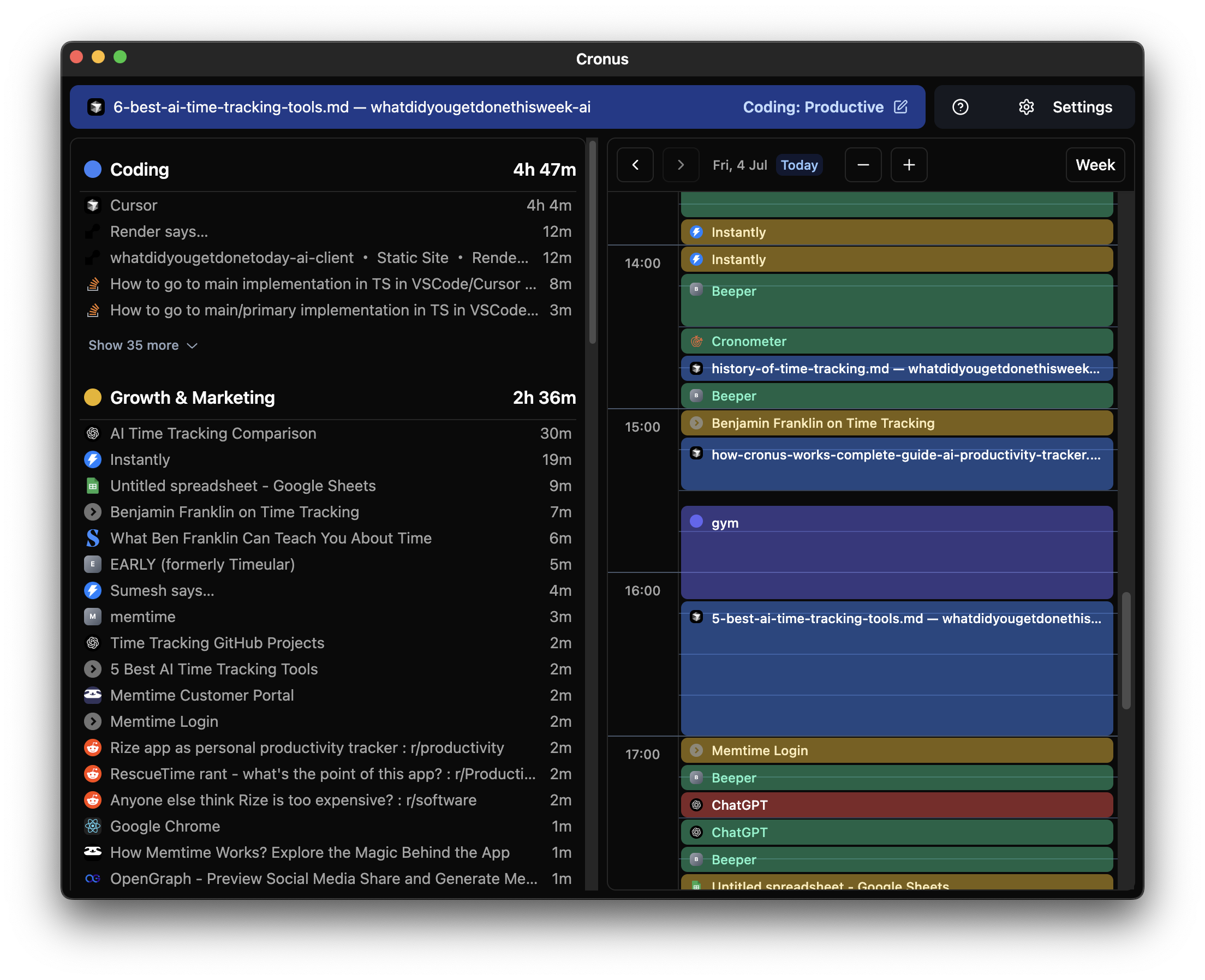
Cronus exists for that. It watches which app and window you are in, works out what the activity meant relative to what you told it you are working on, and keeps the interval and the meaning. No timers to start, so there is no discipline to sustain. No screenshots. Sensitive information is redacted on your device before anything is transmitted. 21 days free, then $6 a month.
What to actually look for
If you do start measuring, these are the numbers that answer this question. Not total hours, which is the number everyone fixates on and the least informative one.
Longest unbroken block. The single best proxy for whether you got real thinking done. If AI saved you six hours and your longest block did not grow, the time went to fragmentation.
Share of the day in your top activity. Did the recovered time concentrate or scatter? Concentration is almost always what you wanted.
Number of distinct contexts. If this went up while total hours stayed flat, you traded depth for volume. That is mechanism two, visible in a single number.
When your best hours happen, and what is in them. Most people have two or three good hours a day. The question is not whether you saved six hours somewhere, it is whether any of them landed in those.
The point
The six-hours statistic is presented as an ending. It is a beginning, and an unexamined one.
Time saved is not time gained. It is only time freed, and freed time goes wherever the strongest ambient pull takes it, which is rarely anywhere you would have chosen.
The gap between those two things is the entire remaining opportunity from AI at work, and it is invisible without measurement.
Try Cronus. Start the baseline now, so that in six months this is a question you can actually answer.
Find out where your week actually goes
The 5-day time audit: one short email a day, walking you through the experiments in this post. You will end the week with a real answer instead of an impression. Free, no app required, and it ends after five days.