How Do You Track Time When Three Agents Are Running at Once?
Every automatic time tracker in existence, ours included, is built on one assumption:
The thing in front of you is the thing you are doing.
Watch the foreground window, note how long it was there, and you have a record of the work. That assumption held for as long as computers have had windows. It is the reason automatic tracking works at all.
Some time in the last year, it stopped being reliably true.
The new shape of a working hour
Here is a real pattern, increasingly ordinary among people who write software in 2026:
You start an agent on a refactor in one repository. While it works, you switch to a second worktree and start another on a bug. You go read the PR from the first one, leave three comments, kick it back. You check the second, it went sideways, you rewrite the prompt. You open a doc to think about a third thing. The first agent finishes and needs review.
Now: how much time did you spend on the refactor?
Your tracker says you had the terminal focused for eleven minutes and the browser focused for twenty-four. Neither number describes the refactor, which occupied maybe forty minutes of wall clock, perhaps six of your attention, and produced a day's worth of code.
METR ran into this directly. In their 2026 survey of technical workers, they note that time-on-task measurements are unreliable for the fraction of developers now running multiple agents concurrently. They could not measure it cleanly, and measuring things carefully is what they do.
Three assumptions that broke at once
It is worth naming these separately, because they fail in different ways.
1. Attention equals progress. Work now happens while you are not watching. An agent grinding through a migration for six minutes is six minutes of progress on that task and zero minutes of anything on your foreground window. Every tracker records the window.
2. One thing at a time. Foreground tracking has exactly one slot. Reality now has three or four concurrent threads with a human rotating between them. There is no way to express "supervising three things" in a model that has one active row.
3. Effort equals value. This one was always shaky and is now badly broken. The hour where you wrote a careful prompt, read the result, rejected it, and rewrote it may have produced more than the four hours where you typed steadily. Time-on-task was always a proxy for contribution. The proxy has gotten much worse.
Why the obvious fixes do not work
"Just track the agents." Read the CLI logs, count agent runtime, attribute it to a task. Except agent wall-clock is not your time, and it is not effort either. An agent running for forty minutes while you eat lunch is not forty minutes of work by any definition that would survive contact with an invoice. It is a machine cost, and mixing it into a human timesheet produces a number that means nothing.
"Track outcomes instead." This is where the engineering-metrics world went, layering DORA, SPACE and DX Core 4 to triangulate. It is the right move for an organization measuring a team over a quarter. It does nothing for a person on a Wednesday afternoon trying to work out why the week feels like it evaporated. Outcome metrics need scale and time to mean anything; the individual question is immediate and n=1.
"Record everything and let an AI sort it out." Screenshot continuously, index it, ask a model later. It genuinely does capture more signal than foreground tracking. It also means a complete indexed record of your digital life sitting on your disk, and when you actually ask it for a day summary, what comes back is app totals, which is the same shallow answer with far more risk attached.
What we think the right answer looks like
We do not have this fully solved. We would rather say that than pretend otherwise. But we think the shape is becoming clear, and it starts by dropping a word.
Stop asking how long you spent on something. Start asking what the time was in service of.
Those came apart. For most of computing history they were the same question, and the availability of the first as a cheap proxy for the second is why time tracking works. Concurrency broke the equivalence.
A tracker that is going to survive this needs three things:
Intent as a first-class input. If the system knows what you are trying to accomplish, it can attribute a fragmented, interleaved afternoon to the right work, even when the foreground window is jumping between four contexts. Without a notion of intent you are just reporting window titles, and window titles have stopped being self-explanatory.
Interval-level truth, not frame-level hoarding. The useful record is "09:00 to 09:12 was the refactor," not a million screenshots you could theoretically reconstruct it from. This is a real architectural position and it is what Cronus stores: the meaning of the span, not its contents.
Honesty about supervision. Time spent reviewing an agent's output is real work and should be recorded as work on that task. Time an agent spent running while you were elsewhere is not your time at all. The two need to be distinguishable, and today, in every tool including ours, they are not.
What Cronus does today, and what it does not
Cronus is goal-aware, which handles more of this than a rule-based tracker can. Because it reasons about what activity means relative to what you told it you are working on, a jump between four windows that all serve the same goal can be understood as one thread rather than four unrelated blips. That is genuinely useful in an interleaved day, and it is the piece we already have.
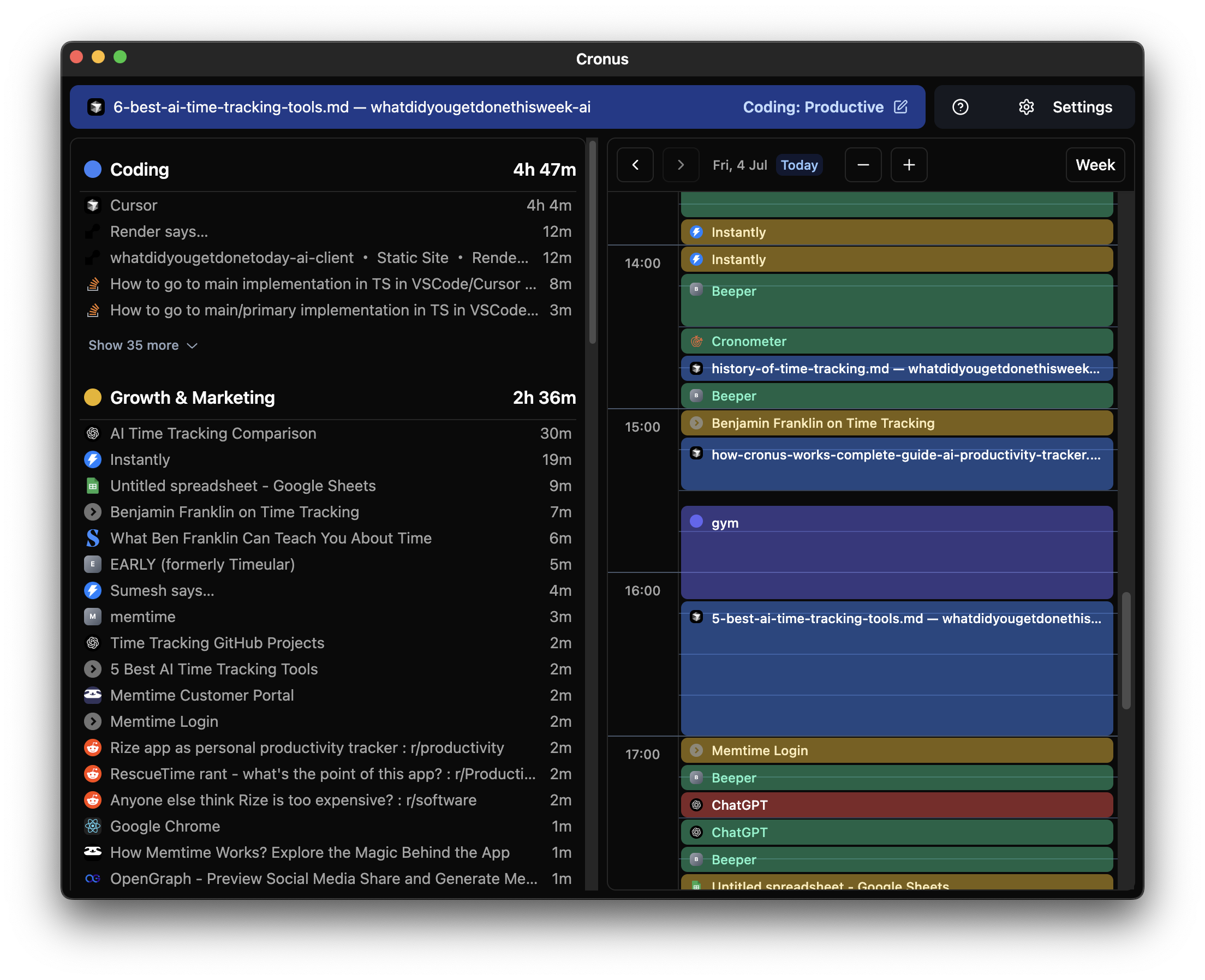
What it does not do yet: it does not know that an agent is running. It cannot tell you that the migration progressed for six minutes while you were in Slack, because from the outside that is indistinguishable from the migration sitting idle. Nothing on the market does this, which is not much of an excuse.
The open question
We think this is the most interesting unsolved problem in time tracking right now, and we would rather write about it honestly than quietly ship a feature and claim the category.
The honest state of things: the entire category measures human attention, attention has become a worse and worse proxy for work, and the gap is widening every time somebody opens a second agent.
If you are working this way and you have found something that gives you a real answer, we would like to hear about it. And if what you want in the meantime is an accurate picture of where your own attention went, which remains most of the problem for most people, Cronus is $6 a month after a 21-day trial and does that well.