Time Tracking for Freelancers
If you charge $100 an hour and bill 20 hours a week, you are not earning $100 an hour. You are earning whatever $2,000 divided by your actual working week comes to, and that week includes everything nobody pays for.
For most freelancers the real figure is 40% to 60% of the headline rate. That gap is the single most useful thing time tracking can tell you, and invoicing software is structurally incapable of showing it.
To put numbers on your own version: the timesheet calculator totals a week across clients, and the salary to hourly calculator converts a target income into the rate it actually implies.
For the invoice
Quickly, because this part is solved.
Toggl Track — free tier is genuinely usable for one person. Projects, clients, rates, good reports. You have to press start. More detail.
Harvest — time and invoicing together, so hours become an invoice without an export step. The most common single-tool answer.
Timely — around $11/mo. Records in the background and drafts entries you approve, which is the right shape if you keep forgetting to start timers.
Clockify — free, and the cheapest way to have projects and rates at all.
FreshBooks or Wave if invoicing, expenses and tax matter more to you than time detail.
The hours nobody pays for
This is the actual freelance problem.
- Finding work. Pitching, proposals, calls that go nowhere, marketplace applications.
- Admin. Invoicing, chasing invoices, contracts, bookkeeping, tax.
- Client management. Emails, revisions, scope conversations, "quick calls".
- Unbilled overrun. The work past the estimate you did not feel able to charge for.
- Learning. Keeping current, which is required and paid by nobody.
- Context switching. Four clients in a day is four projects plus three rebuilds.
A timesheet contains none of this by design, because a timesheet exists to produce an invoice. So the freelancer with excellent records still cannot answer whether the business is working.
The specific failure this causes: taking on a client who pays well per hour but consumes enormous unbilled attention, and not noticing for months, because every signal you look at says they are your best account.
Getting the real number
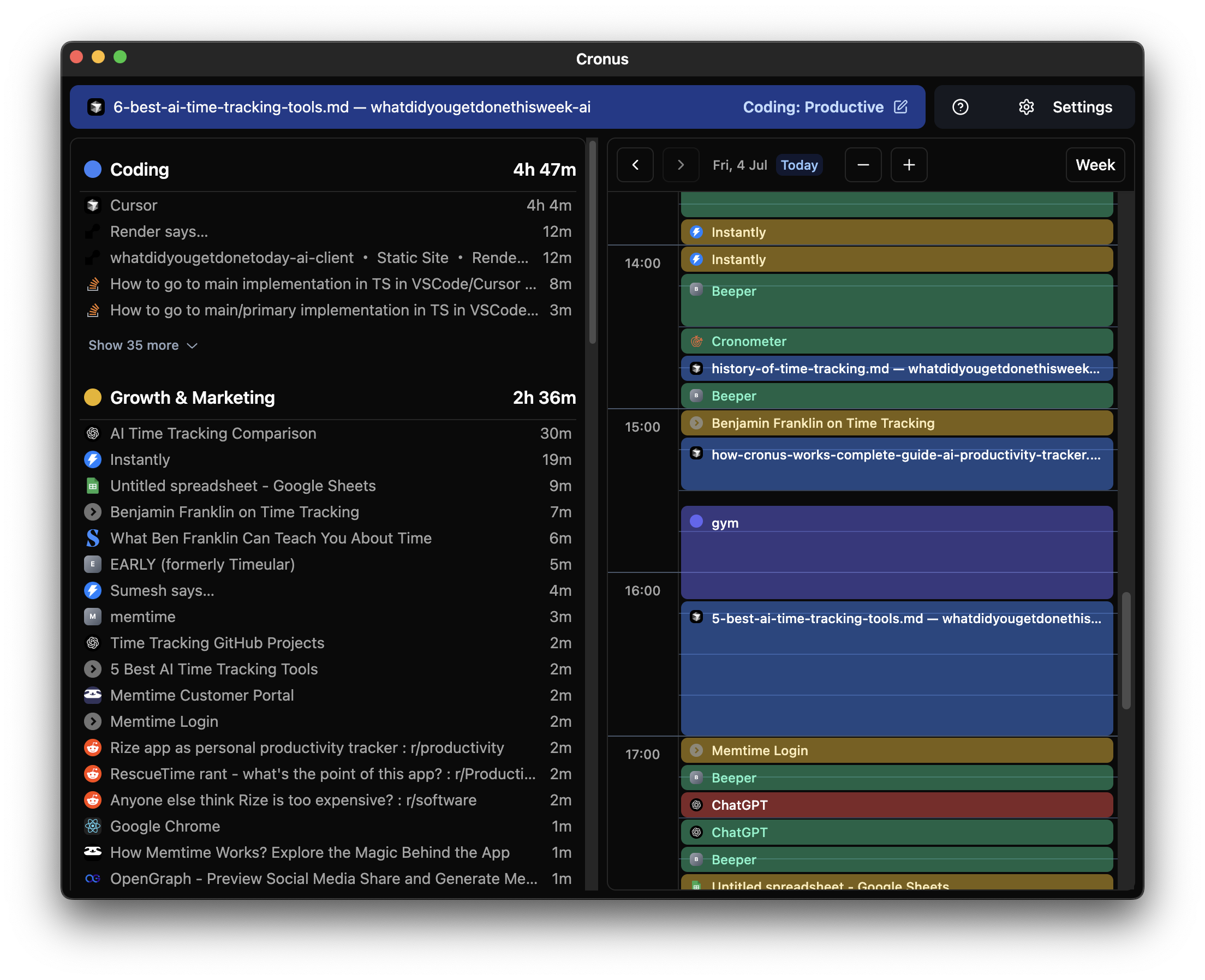
Manual tracking cannot solve this, and it is worth understanding why rather than trying harder. It requires an action at the moment you switch tasks, and unpaid work is the work you are least likely to open a timer for. Nobody starts a timer to chase an invoice. So the record you build is systematically biased toward the billable hours, which are the ones you already knew about.
Cronus records everything automatically on your Mac, with no timer and nothing to log, so unpaid work appears at the same fidelity as paid work.
Three numbers this gives you:
Your effective hourly rate. Income divided by total hours worked, not billed hours. Usually a shock the first time, and the most decision-useful number in your business.
Cost per client, including the unbilled part. This is what reveals the expensive good payer.
The admin share. Once it is a number, it becomes a decision: raise rates, automate it, or hand it to a bookkeeper.
We do not produce invoices. No rates, no client reports, nothing you could send anyone. $6 a month after a 21-day trial, and it never captures your screen: window titles only, redacted on your device.
What to do with the number
Raise your rate to cover the unpaid hours. If you bill 45% of your working week, your rate has to carry the other 55%. This is arithmetic, not confidence.
Move to project pricing where you can. Hourly billing means the unpaid hours are pure loss. Project pricing lets the price cover the whole job, and it is the single biggest structural improvement available to most freelancers.
Fire the expensive client. Easier once "they feel like a lot of work" is a number.
Batch the admin. Scattered admin costs more than the same admin in one block, because of the switching.
Read next
- Time Tracking for Consultants — the same split at a larger scale.
- How to Do a Time Audit — the manual version, and where it breaks.
- Time Tracking Spreadsheet — a template, and its limits.