Time Tracking for Designers
Design projects rarely lose money on the work. They lose it on round four.
The first draft is the part you estimated, and the part you estimated reasonably well. What sinks the project is the revision cycle, which is unbounded by default, poorly logged, and made of increments too small to open a timer for.
Why design is unusually hard to track
The work is not continuous. A design hour is rarely an hour. It is twenty minutes in Figma, a reference hunt, a Slack thread about the brief, ten more minutes, a screenshot for the client. A timer built for "start task, stop task" does not describe this.
Thinking does not look like working. Time spent staring at a layout, walking away from it, or sketching is real design work and is the least likely to be logged. Trackers that measure activity punish exactly the part of the job that produces the good outcome.
Revisions arrive as fragments. "Can we try it in blue" is four minutes. Thirty of those is a day nobody billed.
Feedback rounds are usually uncounted. Reading comments, reconciling contradictory notes from three stakeholders, and the meeting to resolve them are all project cost, and none of it feels like design, so none of it gets recorded.
What to use
Toggl Track — the standard answer. Projects, clients, rates, good reporting, generous free tier. Requires you to press start, which is the whole question in a job made of interruptions. More detail.
Harvest — if you invoice, so time becomes an invoice with no export step.
Timely — around $11/mo, records in the background and drafts entries for you to approve. The best fit for fragmented creative work, because the approval step is far easier than composition.
Timing — macOS only, from about $10/mo, automatic and file-aware, so it can distinguish which document you were in rather than just "Figma". Genuinely useful when one app holds every project you have. More detail.
What to actually measure
Forget total hours. Three numbers change how you quote.
Hours before first delivery, versus hours after. This is the ratio that fixes your estimates. Most designers discover the split is far worse than assumed, and once you know yours, you can quote the whole job instead of the first draft.
Hours per revision round, and how they decay. Round two is substantial. Round five is usually cosmetic and expensive. Knowing where the cliff is tells you where to cap included rounds in the contract.
Non-design hours as a share of the project. Calls, feedback triage, file management, exports, handoff. Frequently a third of a project and almost never quoted for.
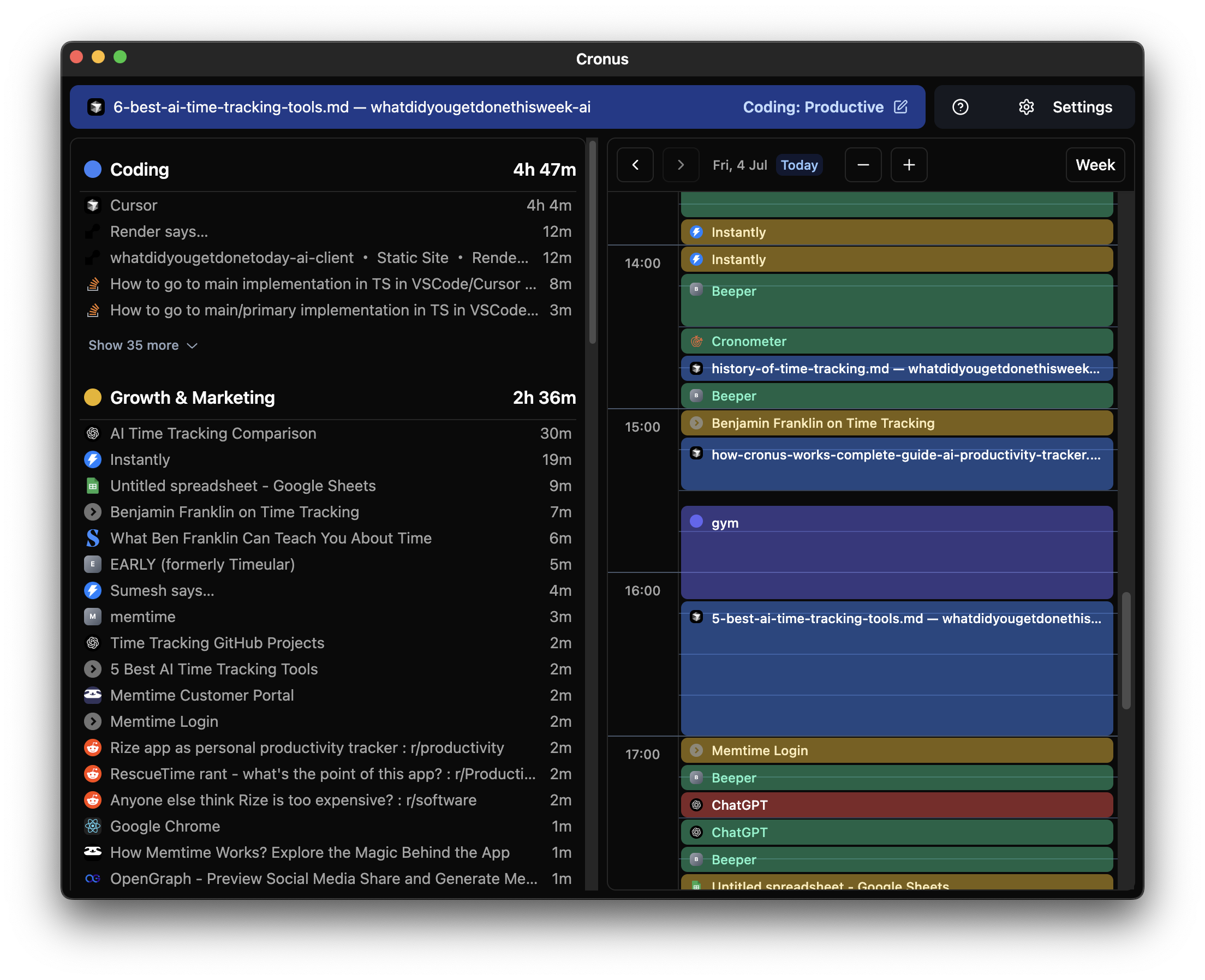
Getting those by hand is difficult for the reason above: the increments are small and the switches are constant, so a manual log captures the long focused stretches and misses the fragments, which is precisely backwards.
Cronus records it automatically on your Mac, with no timer and nothing to log, so the four-minute revisions and the feedback triage show up at the same fidelity as the deep work. It will not produce a client invoice — no rates, no project reports — so pair it with Toggl or Harvest if you bill hourly.
$6 a month after a 21-day trial, and it never captures your screen.
What to do with it
Quote the whole job, not the first draft. If your history says post-delivery work is 60% of a project, your estimate has to include it.
Cap revision rounds in the contract, at the point your data shows the value falls off.
Charge for feedback handling, or fold it into the project price. It is real work and it is currently free.
Price by project, not by hour. Hourly billing means every unlogged fragment is a loss, and design is made of unlogged fragments.
Read next
- Time Tracking for Freelancers — your real hourly rate.
- Cronus vs Timing — if per-document detail matters to you.
- Where Did My Day Go? — fragmentation, which is the shape of this job.