Time Tracking for Accountants
We make a time tracker with no WIP, no client codes, no realisation reporting and no invoicing. For practice billing we are not a candidate, and it is fairer to say that first than to bury it.
What follows is what to use, and the separate measurement problem that billing software is structurally unable to show you.
What billing actually requires
Practice time tracking has requirements most general trackers do not meet.
Client and engagement codes, usually imposed by the firm rather than chosen.
Service line splits, because tax, audit, advisory and bookkeeping are billed and analysed differently.
Work in progress, so unbilled time sits somewhere visible rather than disappearing.
Realisation reporting — billed against recorded — which is the number that tells you whether an engagement is actually profitable.
Human sign-off. If a client challenges a line, someone has to stand behind it. Unsupervised automatic categorisation cannot do that, which is precisely what we do.
What to use
Practice management with time built in is where most firms land, because reconciling two systems is worse than accepting one imperfect one. Karbon, Canopy, Jetpack Workflow and TaxDome all include time and billing attached to jobs. Intuit Practice Management and CCH suites cover the same ground inside the larger vendor ecosystems.
Timely suits smaller practices that do not want full practice management. Its Memory app records in the background and drafts entries you approve, and the approval step is exactly the sign-off requirement rather than friction.
Toggl Track works if your engagement structure is simple and you will reliably press start. Free tier, then $9–$18 a seat.
Harvest if invoicing is currently a separate chore, since time flows to invoice without an export.
The problem billing software cannot show you
Your timesheet records chargeable work. It is not a record of your year, and in this profession the gap is unusually large.
The hours it does not contain:
- Practice admin, software, filing systems, staff questions
- Reviewing junior work, which often is not coded anywhere useful
- Chasing clients for records, which can exceed the engagement itself
- Proposals and onboarding for clients who never signed
- Writing off time before it reaches the bill
- The recovery period after busy season, which costs real capacity
None of that is chargeable. All of it consumes the year. A practice with strong realisation on paper can still be quietly unprofitable once it is included.
Busy season makes this worse in a specific way. During compression, timesheet discipline degrades exactly when the data matters most. Entries get reconstructed on Saturday for a week nobody remembers, and reconstruction smooths out the fragmentation, which was the interesting part.
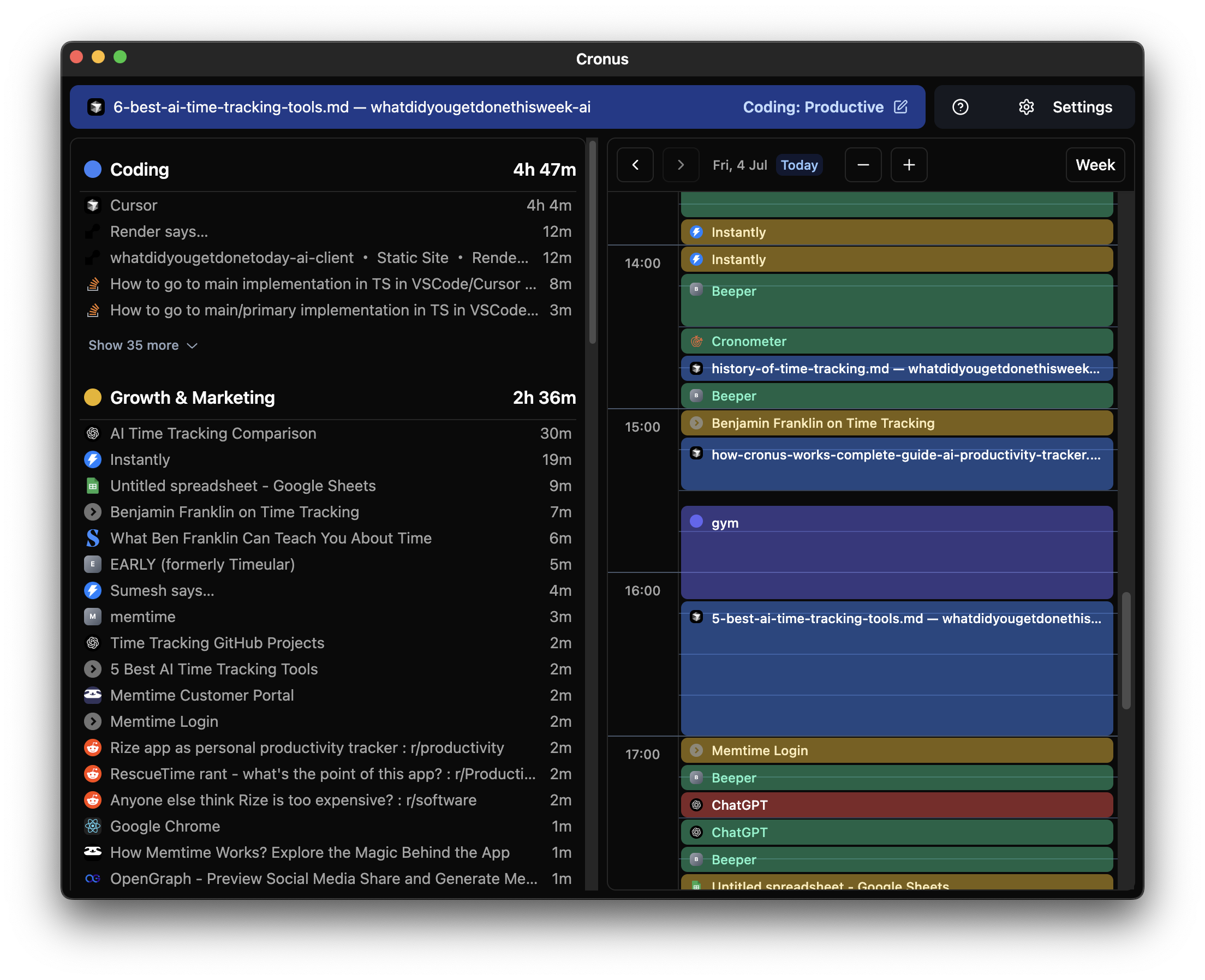
Cronus records where the time actually went, automatically, with no timer and nothing to log. Not to bill from — it produces nothing a client would accept — but so that January to April has a real record rather than a reconstructed one.
What people find: realisation is worse than the system says, once written-off and never-recorded work is visible; and fragmentation is the real busy-season cost, because moving between eleven clients in a day means ten rebuilds, none of which is chargeable and all of which is exhausting.
$6 a month after a 21-day trial, and it never captures your screen: window titles only, with sensitive information redacted on your device.
A word on confidentiality
Window titles routinely contain client names and file references. That is true of every automatic tracker, including ours.
We never capture your screen and we redact sensitive information on-device before transmitting, but metadata does leave the machine, and we will not describe ourselves as local-only. Check that against your firm's policy and your professional body's confidentiality requirements before installing anything on a machine holding client records. If nothing may leave the device, the honest options are local-only tools or none at all.
The short version
For billing: practice management software, or Timely for a small practice.
For understanding the year: something automatic, if confidentiality allows.
Do not ask one tool to do both. A bill needs a signature; a picture of your year needs to happen whether or not anyone was paying attention.
Read next
- Time Tracking for Consultants — the same split, fewer regulations.
- Time Tracking for Lawyers — the strictest version of it.
- How to Do a Time Audit — finding the unbilled half.