How Many Working Days Are in a Year?
2026 has 261 weekdays. After the 11 US federal holidays, it has 250 working days — 2,000 hours at eight hours a day.
2027 also has 261 weekdays and 250 working days.
For a different range, or once your own leave is subtracted, use the work hours calculator.
A typical year contains 260 to 262 weekdays depending on which day it starts on and whether it is a leap year. Below are the month-by-month tables, then the part worth knowing about what this number can and cannot tell you.
2026, month by month
| Month | Weekdays | Holidays | Working days |
|---|---|---|---|
| January | 22 | 2 | 20 |
| February | 20 | 1 | 19 |
| March | 22 | 0 | 22 |
| April | 22 | 0 | 22 |
| May | 21 | 1 | 20 |
| June | 22 | 1 | 21 |
| July | 23 | 1 | 22 |
| August | 21 | 0 | 21 |
| September | 22 | 1 | 21 |
| October | 22 | 1 | 21 |
| November | 21 | 2 | 19 |
| December | 23 | 1 | 22 |
| Total | 261 | 11 | 250 |
2026 begins and ends on a Thursday, which gives it 53 Thursdays. All 11 federal holidays fall on weekdays, so none is "lost" to a weekend.
2027, month by month
| Month | Weekdays | Holidays | Working days |
|---|---|---|---|
| January | 21 | 2 | 19 |
| February | 20 | 1 | 19 |
| March | 23 | 0 | 23 |
| April | 22 | 0 | 22 |
| May | 21 | 1 | 20 |
| June | 22 | 1 | 21 |
| July | 22 | 1 | 21 |
| August | 22 | 0 | 22 |
| September | 22 | 1 | 21 |
| October | 21 | 1 | 20 |
| November | 22 | 2 | 20 |
| December | 23 | 1 | 22 |
| Total | 261 | 11 | 250 |
2027 begins and ends on a Friday. Independence Day falls on a Sunday and is observed Monday 5 July; Christmas Day falls on a Saturday and is observed Friday 24 December.
The variations you probably need
Not counting holidays: 261 weekdays in both 2026 and 2027.
With 10 days PTO: 240 working days, 1,920 hours.
With 20 days PTO (closer to European norms): 230 days, 1,840 hours.
Part-time at 3 days a week: roughly 150 working days.
Not observing all federal holidays: many private employers observe six to eight rather than eleven, which puts you nearer 253–255 days.
A four-day week: roughly 200 days, 1,600 hours at eight-hour days, or 2,000 at ten.
To work out a custom range, our hours calculator handles it including breaks.
What the number is good for
Costing a hire or a project. The most common legitimate use, and the place most estimates go wrong. A full-time person does not deliver 261 days of work. Budget on 230 to 240 once holidays, leave and sick days are included, or your project is late by exactly the amount of leave nobody counted.
Converting salaries. Divide by 2,080 for an hourly equivalent — that is the payroll convention, and using a more "accurate" number makes your figure incomparable to everyone else's.
Capacity planning. Working days per month varies by four between the highest and lowest month, which is a swing of nearly 20%. February and November are consistently short; March, July and December are long. A team plan that treats every month as equal will miss twice a year, predictably.
What it is not good for
Here is the part the other pages on this topic leave out.
A working day is not a day of work. 250 days at eight hours describes availability, not output. Between the two sits the entire reason productivity is hard to measure:
- Meetings, some necessary, most not
- Admin, tooling, compliance, expenses
- The re-entry cost after every interruption, which is real and counted nowhere
- The stretches after lunch or after a difficult conversation where nothing lands
And it runs the other way too: evening email, thinking on the commute, the Sunday hour spent getting ahead. Neither direction appears in any calendar.
So a person scheduled for 2,000 hours might do 1,400 hours of actual work while being mentally occupied for 2,200. The calendar arithmetic is exact. What it implies about your year is not.
Finding your real figure
People estimate their own working time badly. In a randomised controlled trial, experienced developers estimated a tool had made them 20% faster on real tasks from their own repositories. Measured, they were 19% slower — a forty percentage point error about work they had just completed. The full study.
If self-report is that unreliable about the last hour, an annual estimate is not worth planning around.
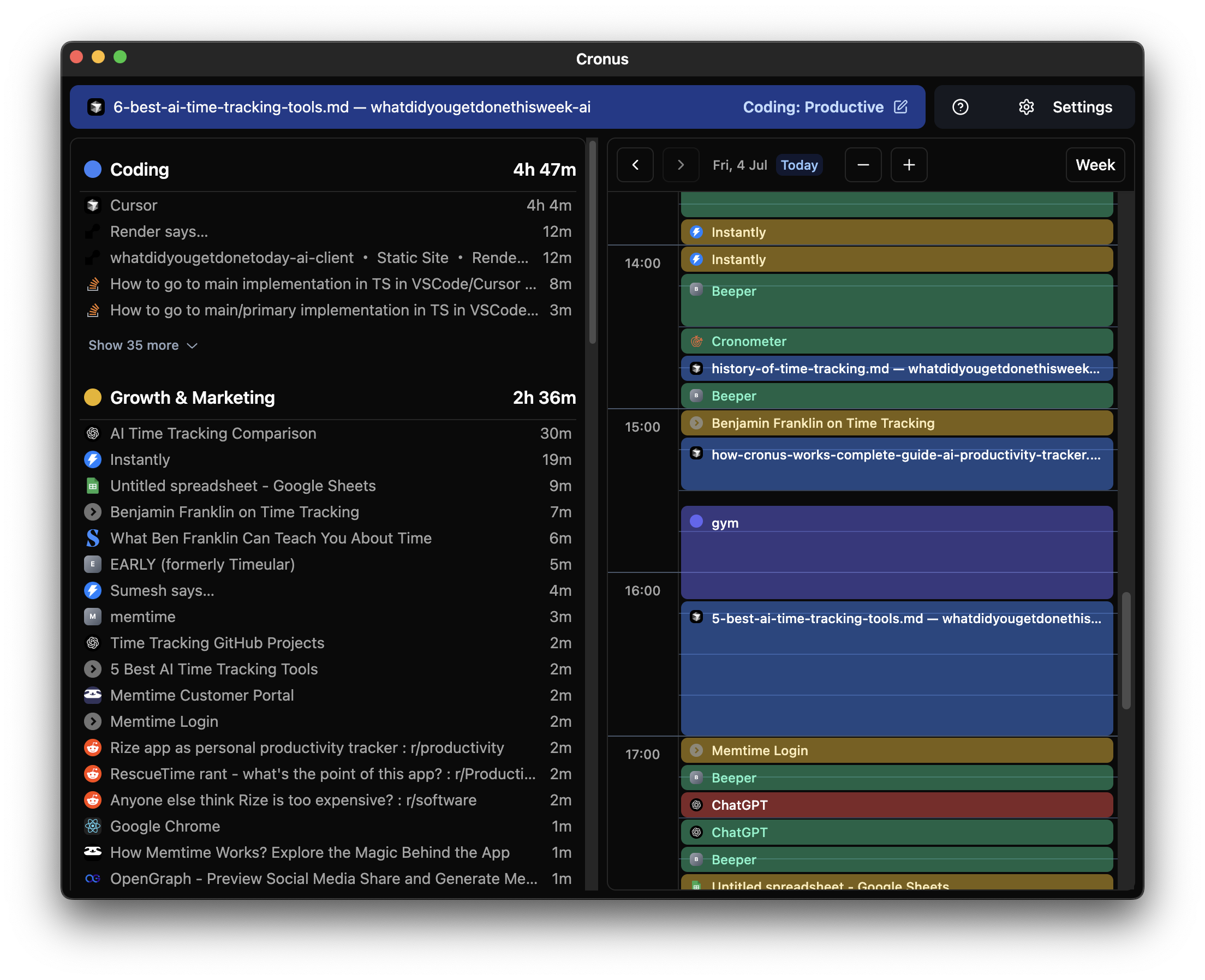
Cronus records where the time actually goes on your Mac, automatically, with no timer and nothing to log. A few weeks gives you a real figure rather than a contractual one — and, more usefully, the split between hours worked and hours spent on what you meant to do.
$6 a month after a 21-day trial, and it never captures your screen: window titles only, with sensitive information redacted on your device.
Stated limits: it sees desk work on a Mac. Meetings away from the laptop, phone calls and thinking on a walk are invisible to it, and it measures the shape of work rather than its quality.
Quick reference
- Weekdays in 2026: 261 · Working days: 250 · Hours: 2,000
- Weekdays in 2027: 261 · Working days: 250 · Hours: 2,000
- Hours in a year: 8,760 (8,784 in a leap year)
- Standard payroll year: 2,080 hours
- Realistic full-time year with 10 days PTO: 1,920 hours
Read next
- How Many Work Hours Are in a Year? — the hours version, and which figure to use when.
- Hours Calculator — custom ranges, including breaks.
- Meeting Cost Calculator — what a recurring meeting costs across 250 days.