ADHD and Gaming
The question that brings most people here is some version of "why can I play for eight hours but not work for twenty minutes?"
The answer is not that you lack discipline. It is that games are engineered to supply exactly the things an ADHD brain struggles to generate internally, and work is not.
Why games are so effective
Compare a game to a work task on the dimensions that actually drive ADHD engagement.
| A game | A work task | |
|---|---|---|
| Goal | Explicit, immediate | Often vague |
| First step | Obvious | Frequently unclear |
| Feedback | Instant, continuous | Delayed by days or months |
| Difficulty | Tuned to keep you just capable | Random |
| Failure | Cheap, instantly retryable | Expensive, sometimes public |
| Novelty | Constantly introduced | Rare |
| Progress | Visible, quantified | Usually invisible |
Every row favours the game, and every row maps onto a known ADHD difficulty. Games solve task initiation by making the first step obvious, solve motivation by making feedback immediate, and solve sustained attention by tuning difficulty continuously.
This is not a flaw in you. It is a product working exactly as designed, built by people who study engagement professionally, competing against a spreadsheet that nobody designed at all.
Worth saying clearly: gaming is not inherently a problem. It is a legitimate interest, a genuine social outlet for a lot of people, and for many with ADHD it is one of the few reliably regulating activities available. The issue is only ever the time, and only when the time is coming from somewhere it was needed.
Why the hours vanish
Two things combine badly.
Games remove every natural stopping cue. No chapter ends, no credits, always another objective already started before the last one finished. Modern design deliberately overlaps goals so there is never a clean exit point.
Time perception depends on sampling the outside world. Absorbed in something, you are not checking anything, so no sense of duration accumulates. Four hours and forty minutes genuinely feel similar from the inside. This is the same mechanism as hyperfixation, and the reason "I'll just play for twenty minutes" fails so reliably.
People are unreliable about elapsed time even when concentrating on work. In a randomised controlled trial, experienced developers were 19% slower with a tool they estimated had made them 20% faster — a forty point error about work they had just finished. The study. Estimating a gaming session is a harder version of the same problem.
What actually helps
Nothing here is about quitting. Most people do not want to and do not need to.
External stopping cues, not internal ones. An alarm in another room, a smart plug on a timer, a calendar event with an actual alert. Anything relying on you noticing is relying on the faculty that is offline.
Make the cue require movement. A dismissible notification loses every time, because dismissing is free. Standing up breaks the state, which is most of the effect.
Play after, not before. Gaming first and working after almost never happens. Working first and gaming after works, because the game does not need activation energy and the work does. Sequencing beats willpower.
Choose games with natural exits when time matters. A roguelike run, a single match, a level. Open-world and progression-heavy games are specifically designed to have no exit, which is a fine choice on a Saturday and a bad one on a Tuesday evening.
Do not put it on the machine you work on. Ten seconds of friction is worth more than any intention.
Let it run when the cost is low. A free weekend is what this is for. The problem is a Tuesday with a deadline, and those are separable.
Borrowing what games do well
The more useful move than restricting gaming is stealing its mechanics for work, because the comparison table above is essentially a design brief.
Make the first step explicit. Most work tasks fail at initiation because the first action is undefined. "Write the report" has no first step; "open the document and write the heading" does.
Shorten the feedback loop. Break work into pieces that finish today. Something completed produces the signal that keeps you going.
Make progress visible. Games quantify everything. Work usually quantifies nothing, which is why a productive week can feel like nothing happened.
Tune the difficulty. Too easy is as disengaging as too hard. Genuinely boring tasks need artificial difficulty added — a time challenge, a constraint, doing it in an unusual way.
Make failure cheap. Draft badly on purpose. Games let you retry instantly; work often carries a fear of getting it wrong that prevents starting at all.
Getting the actual number
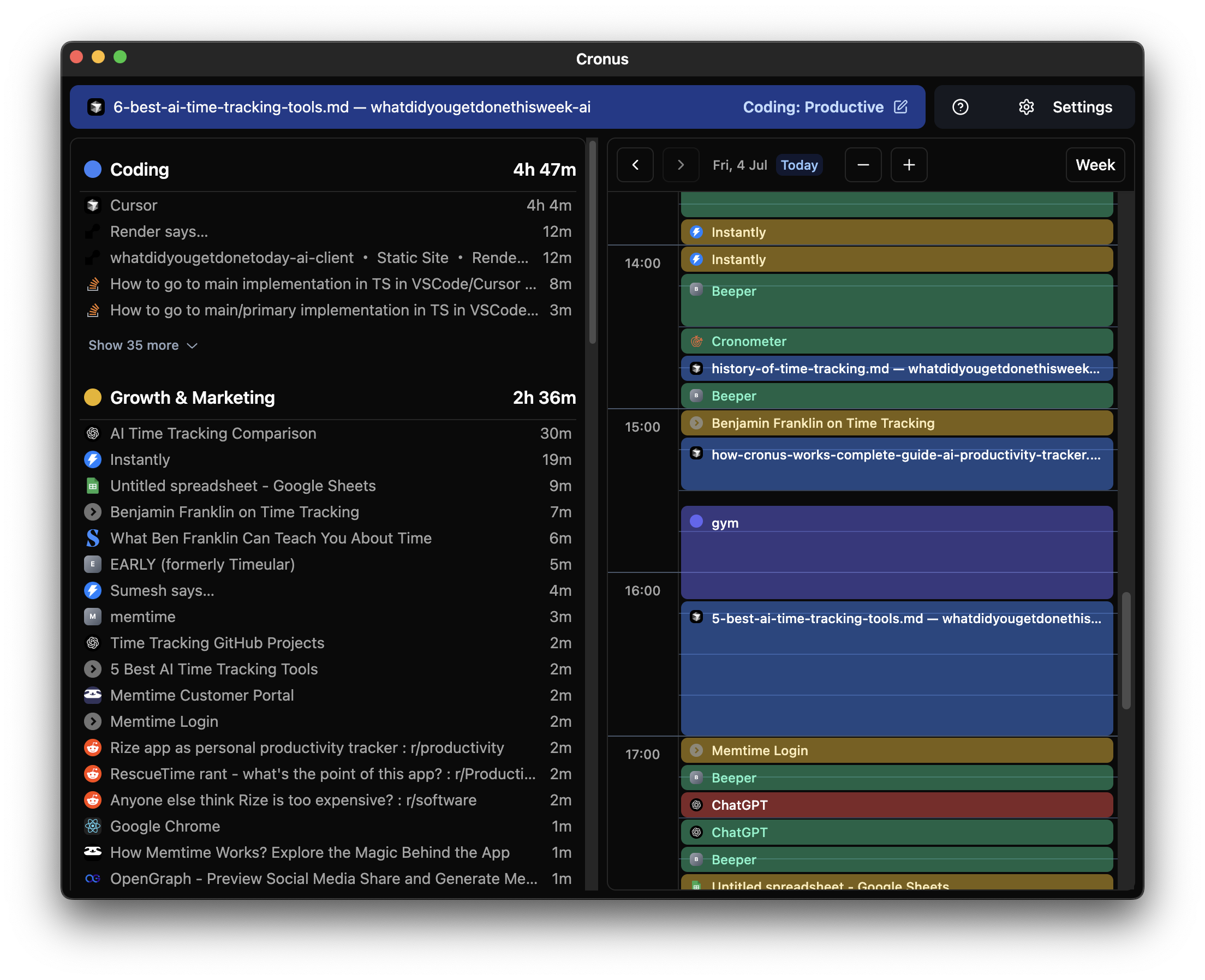
Most people significantly underestimate their gaming hours, and not through dishonesty — absorbed time leaves very little memory, so there is nothing to count.
Cronus records automatically on your Mac, with no timer and nothing to log, which matters here because nobody pauses a session to log it. It also means the record includes the evenings you would have described as "an hour or so".
The useful output is one number a week rather than a daily verdict. If it is four hours and you are content with that, you have learned something reassuring. If it is twenty and you have been telling yourself it is six, that is worth knowing before you conclude anything about yourself.
$6 a month after a 21-day trial, and it never captures your screen.
Real limits. It only sees your Mac, so a console or a phone is invisible — and for a lot of people that is where the hours actually are. And it will not stop you: it is a record, not an intervention, and no tracker beats a game for attention.
When it is worth taking seriously
Most heavy gaming is a hobby with scheduling consequences. Some is not. Worth talking to someone if you are gaming to avoid distress rather than for enjoyment, if it is costing sleep to a degree affecting your health, if you have tried to cut down repeatedly and not managed it, or if it is damaging work or relationships and continuing anyway.
Gaming disorder is a recognised diagnosis, and it is also over-applied to people who simply have a time-consuming hobby. The distinguishing question is usually whether you still enjoy it.
Read next
- Hyperfixation — the same absorption, applied elsewhere.
- How to Stop Doomscrolling — the same design problem, worse.
- The Dopamine Menu — planning what you reach for.