Is Time Still the Right Unit of Work?
Every few years someone declares that measuring knowledge work in hours is obsolete. In 2026 the argument is louder than usual and better supported than usual, and it goes like this: AI has decoupled effort from output, so counting hours measures the wrong thing entirely.
There is something to it. But hours have now outlived every metric that was supposed to replace them, and it is worth understanding why before you throw them out.
The graveyard
Lines of code. Dead for decades, and rightly. Rewarded verbosity, punished deletion. AI finished it off: LOC is now a measure of how much you let a model type.
Commits and pull requests per week. The 2010s favourite. Held up reasonably until AI-assisted workflows inflated the volume without moving the value. A developer shipping fifteen small AI-drafted PRs is not obviously outproducing one shipping three considered ones, and by 2026 nearly everyone had concluded these counts were unreliable on their own.
Story points. Never measured anything about reality. They measured a team's shared social estimate of a thing, which is useful for planning and worthless for retrospective truth.
Velocity. Story points with a trend line.
The response, sensibly, was to stop looking for one number. DORA gave delivery metrics: deployment frequency, lead time, change failure rate, recovery time. SPACE added the dimensions DORA missed: satisfaction, performance, activity, communication, efficiency. DX Core 4 tried to consolidate. The 2026 consensus among people who study this is that you need at least three dimensions and that no single metric survives alone.
All of that is correct, and all of it is about teams over quarters.
The question those frameworks do not answer
None of it helps you on a Wednesday afternoon.
DORA cannot tell you why your week felt fragmented. SPACE cannot tell you that your mornings, the only hours you think clearly, have been colonized by standup and Slack. Change failure rate has nothing to say about the fact that you meant to spend the day on the migration and spent it on everything else.
These are not deficiencies in the frameworks. They are organizational instruments, and they need scale and time to produce signal. The individual question is immediate and n=1.
At n=1, time is still the only unit that works. Here is why.
Why hours survive
Time is conserved. This is the property nothing else has. You cannot have more than twenty-four hours in a day, so every hour spent on one thing is provably not spent on another. Lines of code are not conserved. Pull requests are not conserved. Story points are definitionally not conserved. Only time forces a real trade-off, and a real trade-off is what makes a measurement decision-relevant.
Time is observable without cooperation. You can measure it without the subject agreeing, remembering, or self-reporting. Given the forty-point gap between what people believe about their hours and what their hours actually are, any metric that depends on self-report is compromised before it starts.
Time is comparable across kinds of work. An hour of writing, an hour of code review and an hour of meetings sit in one ledger. No output metric spans the writer, the designer, the engineer and the founder.
Time is what you actually spend. Whatever you produce, the thing that left your life to produce it was hours.
The real critique, taken seriously
The strongest version of the argument against hours is not that they measure nothing. It is that hours measure input, and AI has broken the input-output relationship, so tracking input tells you less than it used to.
That is true and worth sitting with.
METR's 2026 survey found technical workers reporting a median 3x speedup from AI, while their reported value gain was 1.4x to 2x. The researchers point out that speed estimates run high partly because people substitute toward tasks AI does fast, regardless of whether those tasks matter. Time-on-task got cheaper. It did not get more meaningful.
And when several agents run concurrently, time-on-task stops being well defined at all.
So: an hour is a worse proxy for contribution than it was in 2020. Agreed.
What that argument actually implies
It implies you should stop treating hours as a score. It does not imply you should stop measuring them.
The mistake is thinking a time measurement is a performance measurement. It never was a good one. Its value was never that more hours are better.
Its value is that it is the only complete, honest account of where your life went, and everything you might want to improve is downstream of that account being accurate.
You cannot decide to protect your mornings without knowing that your mornings are gone. You cannot decide a project was not worth it without knowing it took eleven hours. You cannot notice that AI made a task fast and worthless without noticing you did it eight times this week.
Hours are not the scoreboard. They are the ledger. The scoreboard was always outcomes, and it always will be.
The unit that actually changed
If anything needs updating, it is not the hour. It is what we attach to it.
The old model recorded duration plus label: two hours, Project X. That was fine when a day was three blocks long.
It fails now, because the label stopped being self-explanatory. A window title in a fragmented, agent-interleaved afternoon does not tell you what the time was for.
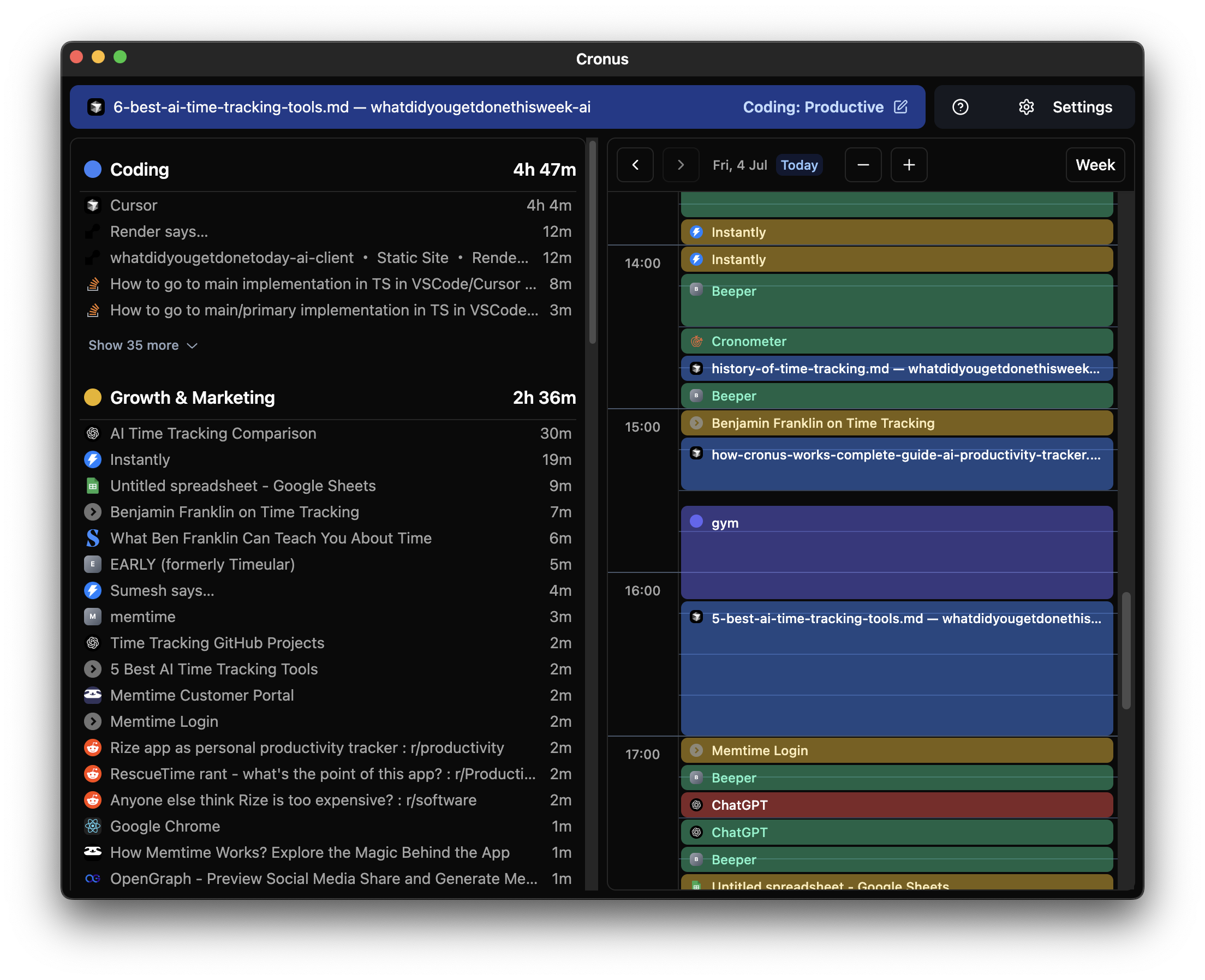
The unit that works in 2026 is duration plus intent: two hours, in service of shipping the migration. That is a different measurement, and it is why we built Cronus to be goal-aware rather than category-aware. It judges activity against what you said you were trying to do, so an afternoon jumping across four windows toward one goal reads as one thread rather than four fragments.
So, is it?
Yes, with one amendment.
Time is still the right unit for the individual, because it is conserved, observable, universal and honest, and because every replacement proposed in forty years has either measured the wrong thing or been gameable by the person being measured.
Outcomes are the right unit for organizations, and DORA plus SPACE plus DX Core 4 is a reasonable attempt at that.
The amendment is that a duration on its own is no longer enough. An hour with no notion of what it was in service of is a number without a subject, and in a working day made of interleaved threads and background agents, that number has stopped explaining itself.
Try Cronus and gives you the ledger, with the intent attached.