Time Theft
Time theft is being paid for time you did not work.
The term is heavily promoted by employee monitoring vendors, for an obvious reason: it converts a management problem into a security problem, and security problems justify buying software. So it is worth separating what the term actually covers from what it is used to sell.
We make a time tracker and we do not sell monitoring software. Cronus is single-user, has no manager view, and is not usable for oversight of employees. That shapes this page, and you should read it knowing that.
What it actually means
The narrow, defensible definition covers deliberate falsification of hours:
Buddy punching — clocking in for a colleague who is not there. The clearest case, and the one with real measurable cost in shift work.
Timesheet falsification — recording hours not worked. Also clear.
Unauthorised extended breaks taken as paid time, systematically rather than occasionally.
Working a second job during hours billed to the first — the "overemployment" case, which is a genuine contract breach.
That list is the honest scope. It describes deception, and deception is a legitimate thing for an employer to care about.
What gets called time theft and is not
The term expands, in vendor marketing, to cover essentially any moment an employee is not producing:
- Checking a phone
- A conversation with a colleague
- Slow periods where there is no work to do
- Reading something unrelated
- Bathroom breaks and coffee
- Thinking, which registers as inactivity on every monitoring tool ever built
None of this is theft. It is what a human day looks like. Nobody produces eight continuous hours of output, has ever produced eight continuous hours of output, or will.
The tell is the measurement. Monitoring software counts keystrokes, mouse movement and active windows, because those are measurable. It cannot measure value. So a developer thinking hard about an architecture problem scores zero and a person reformatting a spreadsheet scores full marks, which is precisely backwards.
The evidence problem
Vendor pages quote large figures — a percentage of payroll lost, hours per employee per week. Those figures are almost always produced by the companies selling the remedy, from surveys with undisclosed methodology, and they should be treated accordingly.
What is better established:
Buddy punching in shift-based hourly work is a real, measurable cost, and biometric clock-ins largely solve it. That is a narrow problem with a narrow fix.
Monitoring knowledge work does not reliably improve output. The measurable outcomes are increased stress, reduced trust and — repeatedly — behaviour optimised for the metric rather than the job.
Surveillance changes behaviour in the wrong direction. People stop taking thinking time, because thinking looks like idleness. They stop reporting problems early, because the record can be used against them. They keep a window active while doing nothing. The activity metric goes up, the work does not.
If you install monitoring and activity scores rise, you have not learned that people are working harder. You have learned they know what is measured.
What the real cost usually is
Organisations worried about time theft are almost always looking at the smaller number.
Meetings. Ten people in a recurring hour is ten hours a week, 500 a year. That dwarfs anything an individual could plausibly steal, and it is fully visible in a calendar nobody audits. Our meeting cost calculator does the arithmetic.
Fragmentation. Work broken into twenty-minute pieces produces far less than the same hours in blocks. The lost capacity here is enormous and shows up in no report.
Busywork. Reports nobody reads, duplicate data entry, approval chains with no judgement in them. The absence test finds these quickly.
Waiting. Blocked on approvals, on someone else's output, on access nobody granted. Frequently the single largest source of unproductive paid time, and never described as theft because nobody is at fault in a way that is convenient to name.
Bad matching. People doing work they are poorly suited to, slowly.
All five are larger than deliberate time theft in essentially every knowledge-work organisation, and all five are management problems rather than employee-integrity problems. That is precisely why the theft framing is attractive: it locates the failure in the cheapest possible place.
If you are an employer
For hourly and shift work, a clock-in system with biometric or photo verification solves buddy punching. That is a proportionate fix for a real problem, and it is where the legitimate concern lives.
For salaried knowledge work, measure outcomes. This is harder, which is why people reach for activity metrics instead — but an activity metric is a proxy that is trivially gamed and actively harmful to the work you actually want.
If you have one underperforming person, address that directly. Installing surveillance across a team to avoid one difficult conversation costs you the team's trust and does not resolve the conversation.
Check your obligations before installing anything. Monitoring is regulated, and the rules vary considerably by jurisdiction. In the EU and UK, GDPR requires a lawful basis, transparency and usually a data protection impact assessment; covert monitoring is very hard to justify. Several US states require notice or consent. "The vendor said it was fine" is not a defence.
If you are an employee
Know what is installed. In most jurisdictions you are entitled to be told. Ask, and ask what is retained and for how long.
Do not hand over personal tracking data. If you use a tool like ours for yourself, that data is yours. Bring a conclusion if you need to make a case — "my longest unbroken block on meeting days is 34 minutes" — never the underlying log. Once raw data is shared it becomes a performance record you did not agree to, and it will be read in ways you cannot control. More on that here.
The gap is usually structural. If you are producing less than expected, the cause is far more often fragmentation, unclear priorities or blocked work than anything you are doing wrong.
Where we stand
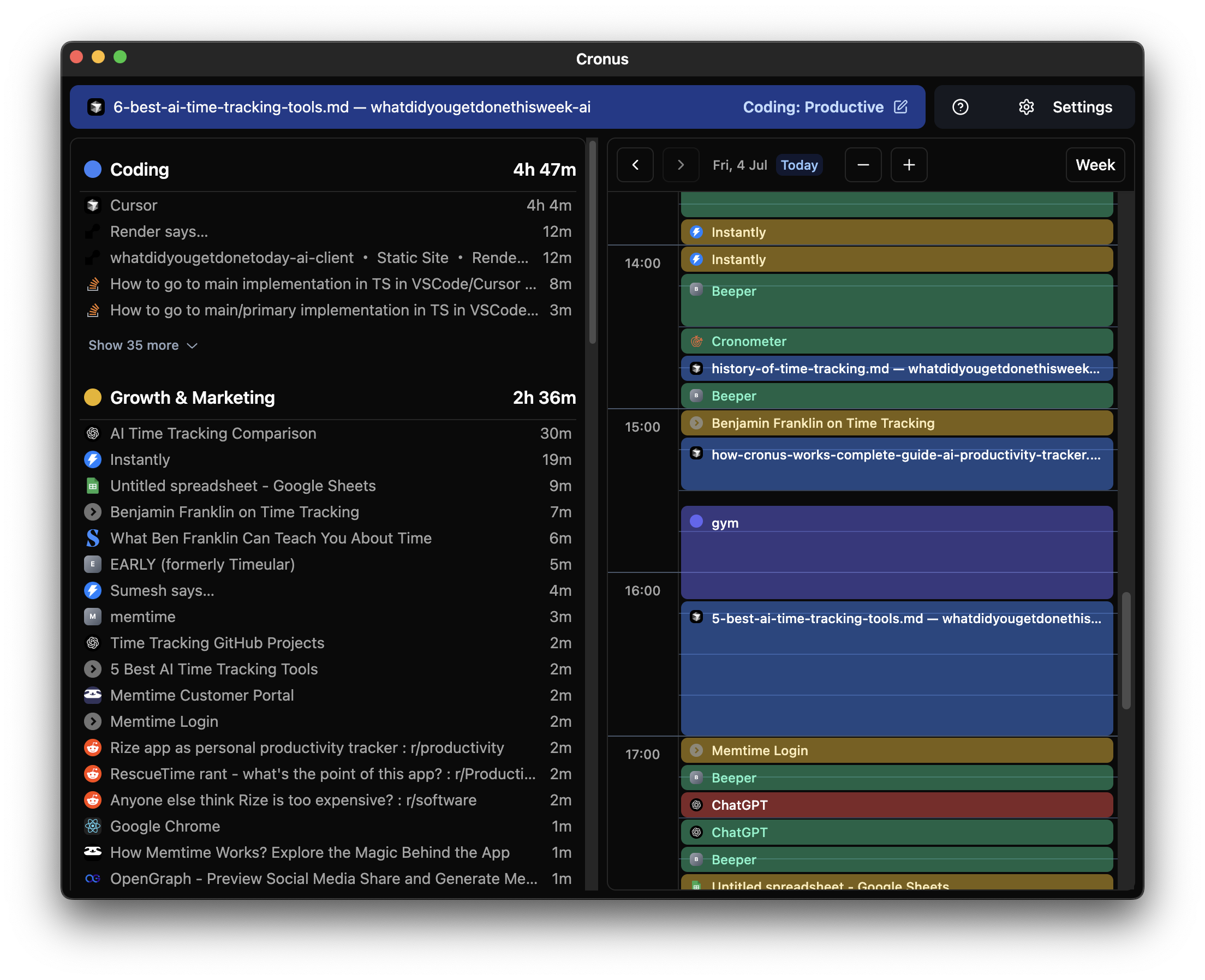
Cronus is a personal tool. It records what you did on your own Mac so you can see where your time went — no manager view, no team dashboard, no reports to anyone else, and it never captures your screen.
We are not neutral on this. Personal measurement makes people better at their own work. Surveillance makes them better at looking busy, and we do not want to build the second thing.
If you are here looking for software to monitor staff, we are the wrong product, and the section above on what the real cost usually is will do more for you than any monitoring tool.
$6 a month after a 21-day trial, if the personal version is what you want.
Read next
- Too Many Meetings — the cost that dwarfs this one.
- Busywork — how to find it without surveilling anyone.
- Agency Time Tracking — what to use for real project profitability.